Showing posts with label Condiment of the Week. Show all posts

Thursday, June 23, 2016

Condiment of the Week - Steak sauce

Steak sauce is a dark brown sauce commonly served as a condiment for beef, in the United States.
Two types of steak sauce
The original sauce from which "steak sauce" is derived is known in Britain as "brown sauce". Steak sauce is also derived from "brown sauce" in Japan, called tonkatsu sauce, which has a slight variation in ingredients.


Steak sauce is normally brown or orange in color, and often made from tomatoes, spices, vinegar, and raisins, and sometimes anchovies. The taste is either tart or sweet, with a peppery taste similar to Worcestershire sauce. Three major brands in the U.S. are Lea & Perrins, Heinz 57, and A1 Steak Sauce (a tart variant). There are also numerous regional brands that feature a variety of flavor profiles. Several smaller companies and specialty producers manufacture steak sauce, as well, and most major grocery store chains offer private-label brands. These sauces typically mimic the slightly sweet flavor of A1 or Lea & Perrins.

Heinz 57 steak sauce, produced by H. J. Heinz Company, is unlike other steak sauces in that it has a distinctive dark orange-yellow color and tastes more like ketchup spiced with mustard seed. Heinz once advertised the product as tasting "like ketchup with a kick".


Thursday, June 16, 2016

Condiment of the Week - Sesame Oil

Sesame oil is an edible vegetable oil derived from sesame seeds. Besides being used as a cooking oil
Sesame seed oil in clear glass vial
in South India, it is often used as a flavor enhancer in Korean, Chinese, Japanese, Middle Eastern, and Southeast Asian cuisine. It has a distinctive nutty aroma and taste.

The oil from the nutrient-rich seed is popular in alternative medicine, from traditional massages and treatments to the modern day.

The oil is popular in Asia and is also one of the earliest-known crop-based oils, but world-wide mass modern production continues to be limited even today due to the inefficient manual harvesting process required to extract the oil.


Sesame oil is composed of the following fatty acids: linoleic acid (41% of total), oleic acid (39%), palmitic acid (8%), stearic acid (5%) and others in small amounts.


Sesame seeds are protected by a capsule which only bursts when the seeds are completely ripe. The ripening time tends to vary, so farmers cut plants by hand and place them together in an upright position to continue ripening until all the capsules have opened. The discovery of an indehiscent (nonshattering) mutant by Langham in 1943 began the work towards development of a high yielding, shatter-resistant variety. Although researchers have made significant progress in sesame breeding, harvest losses due to shattering continue to limit domestic US production.

Sesame seeds are primarily produced in developing countries, a factor that has played a role in
White sesame seeds, mostly unshelled.
limiting the creation of large-scale, fully automated oil extraction and processing techniques. Sesame oil can be extracted by a number of methods, depending on the materials and equipment available.

In developing countries, sesame oil is often extracted with less-expensive and manually intensive techniques such as hot water flotation, bridge presses, ram presses, the ghani process, or by using a small-scale expeller. In developed countries sesame oil is often extracted using an expeller press, larger-scale oil extraction machines, or by pressing followed by chemical solvent extraction.

Sesame oil can also be extracted under low-temperature conditions using an expeller press in a process called cold pressing. This extraction method is popular among raw food adherents because it avoids exposing the oil to chemical solvents or high temperatures during extraction.


There are many variations in the color of sesame oil: cold-pressed sesame oil is pale yellow, while Indian sesame oil (gingelly or til oil) is golden, and East Asian sesame oils are commonly a dark brown color. This dark color and flavor are derived from roasted/toasted sesame seeds. Cold pressed sesame oil has a different flavor than the toasted oil, since it is produced directly from raw, rather than toasted, seeds.

Sesame oil is traded in any of the forms described above: Cold-pressed sesame oil is available in Western health shops. Unroasted (but not necessarily cold pressed) sesame oil is commonly used for cooking in the Middle East and can often be found in halal markets. In East Asian countries, different kinds of hot-pressed sesame oil are preferred.


The only essential nutrient having significant content in sesame oil is vitamin K, providing 17% of the Daily Value per 100 grams (ml) consumed supplying 884 calories. For fats, sesame oil is approximately equal in monounsaturated (oleic acid) and polyunsaturated (linoleic acid) fats, totaling together 80% of the fat content. The remaining oil content is primarily the saturated fat, palmitic acid (about 9% of total, table).


Despite sesame oil's high proportion (41%) of polyunsaturated (Omega-6) fatty acids, it is least prone, among cooking oils with high smoke points, to turn rancid when kept in the open. This is due
Bottling sesame oil 
to the natural antioxidants present in the oil.

Light sesame oil has a high smoke point and is suitable for deep-frying, while dark sesame oil (from roasted sesame seeds) has a slightly lower smoke point and is unsuitable for deep-frying. Instead it can be used for the stir frying of meats or vegetables, sautéing, or for the making of an omelette.

Sesame oil is most popular in Asia, especially in Korea, China, and the South Indian states of Karnataka, Andhra Pradesh, and Tamil Nadu, where its widespread use is similar to that of olive oil in the Mediterranean.

East Asian cuisines often use roasted sesame oil for seasoning.
The Chinese use sesame oil in the preparation of meals.
In Japan, rāyu, is a paste made of chili-sesame oil seasoning - and used as a spicy topping on various foods - or mixed with vinegar and soy sauce - and used as a dip.
In South India - before the advent of modern refined oils produced on a large scale, sesame oil was used traditionally for curries and gravies. It continues to be used, particularly in Tamil Nadu and Andhra Pradesh, mixed with foods that are hot and spicy as it neutralizes the heat. It is often mixed in with a special spice powder that accompanies Idly, dosa as well as rice mixed with spice powders ([Paruppu Podi]). It is also used in pickles and condiments mainly in Andhra Pradesh.

Thursday, June 9, 2016

Condiment of the Week - Sauerkraut

Sauerkraut (/ˈsaʊərkraʊt/; German pronunciation: [ˈzaʊ.ɐˌkʁaʊt] ( listen)) is finely cut cabbage that
German sauerkraut
has been fermented by various lactic acid bacteria, including Leuconostoc, Lactobacillus, and Pediococcus. It has a long shelf life and a distinctive sour flavor, both of which result from the lactic acid that forms when the bacteria ferment the sugars in the cabbage.


Fermented foods have a long history in many cultures, with sauerkraut being one of the most well-known instances of traditional fermented moist cabbage side dishes. The Roman writers Cato (in his De Agri Cultura) and Columella (in his De re Rustica) mentioned preserving cabbages and turnips with salt.

Sauerkraut took root mostly in Eastern European and Germanic cuisines, but also in other countries
Homemade sauerkraut
including the Netherlands, where it is known as zuurkool, and France, where the name became choucroute. The English name is borrowed from German where it means literally "sour herb" or "sour cabbage". The names in Slavic and other East European languages are not cognate with German sauerkraut, but have similar meanings: "fermented cabbage" (Belarusian: квашаная капуста, Czech: kysané zelí, Polish: kiszona kapusta, Lithuanian: rauginti kopūstai, Russian: квашеная капуста, tr. kvashenaya kapusta, Ukrainian: квашена капуста) or "sour cabbage" (Bulgarian: кисело зеле, Czech: kyselé zelí, Hungarian: savanyúkáposzta, Russian: кислая капуста, tr. kislaya kapusta, Serbian: kiseli kupus, Slovak: kyslá kapusta, Ukrainian: кисла капуста, Romania: varză murată). In Poland name kwaszona kapusta ("soured cabbage") is also used, but it indicates that cabbage might have been fermented in less traditional way.

Before frozen foods, refrigeration, and cheap transport from warmer areas became readily available in northern, central and eastern Europe, sauerkraut, like other preserved foods, provided a source of nutrients during the winter. James Cook always took a store of sauerkraut on his sea voyages, since experience had taught him it prevented scurvy.

During World War I, due to concerns the American public would reject a product with a German name, American sauerkraut makers relabeled their product as "Liberty cabbage" for the duration of the war.

During World War I, British and Commonwealth forces used the word Kraut, derived from the dish, as a derogatory term for the German people. During World War II, the term was picked up by American Forces.


In Belarusian, Russian and Ukrainian cuisine, chopped cabbage is usually pickled together with
Eastern European style sauerkraut 
shredded carrots. Other ingredients may include whole or quartered apples for additional flavor or cranberry for flavor and better keeping (the benzoic acid in cranberries is a common preservative). Bell peppers also known to be added as they improve the looks of the completed dish. The resulting sauerkraut salad is typically served cold, as a zakuski or a side dish. There is also a home made type of very mild sauerkraut where white cabbage is pickled with salt in a refrigerator for only between three and seven days. This results in very little lactic acid being produced. Typically wider strips of 1 to 2 centimeters (1") are used rather than the shredded cabbage used for traditional sauerkraut. This type is popular when eaten with zakuski.

Sauerkraut is used as a filling for Polish pierogi, Ukrainian varenyky, Russian pirogi and pirozhki. Sauerkraut is also the most important ingredient in traditional soups, such as shchi (a national dish of Russia), kapusniak (Poland and Ukraine), kwaśnica (Poland), kapustnica (Slovakia), and zelňačka (Czech Republic). It is a common ingredient of Polish bigos (a hunter's stew).

In Germany, cooked sauerkraut is often flavored with juniper berries or cumin seeds, apples and white wine are popular variations. Traditionally it is served warm, with pork (e.g. eisbein, schweinshaxe, Kassler) or sausages (smoked or fried sausages, Frankfurter Würstchen, Vienna sausages, black pudding), accompanied typically by roasted or steamed potatoes or dumplings (knödel or schupfnudel). Similar recipes are common in other Central European cuisines. The Czech national dish vepřo knedlo zelo consists of roast pork with knedliky and sauerkraut.

Sauerkraut is the main ingredient of the Alsatian meal choucroute garnie (French for "dressed sauerkraut"), sauerkraut with sausages (Strasbourg sausages, smoked Morteau or Montbéliard sausages), charcuterie (bacon, ham, etc.), and often potatoes. Usually it is cooked with Alsatian white wines.

Sauerkraut, along with pork, is eaten traditionally in Pennsylvania on New Years Day. The tradition, started by the Pennsylvania Dutch, is thought to bring good luck for the upcoming year. Sauerkraut is also used in American cuisine as a condiment upon various foods, such as sandwiches and hot dogs.


Many health benefits have been claimed for sauerkraut.

* It is a source of vitamins C, B, and K; the fermentation process increases the bioavailability of nutrients rendering sauerkraut even more nutritious than the original cabbage. It is also low in calories and high in calcium and magnesium, and it is a very good source of dietary fiber, folate, iron, potassium, copper and manganese.
* If unpasteurized and uncooked, sauerkraut also contains live lactobacilli and beneficial microbes and is rich in enzymes. The fiber and supply of probiotics improve digestion and promote the growth of healthy bowel flora, protecting against many diseases of the digestive tract.
* Sauerkraut has been used in Europe for centuries to treat stomach ulcers, and its effectiveness for soothing the digestive tract has been well established by numerous studies.
* Raw sauerkraut is distinctly different from store-bought, canned sauerkraut. While many food manufacturers can or jar their kraut using heat in order to extend shelf life, raw sauerkraut is lacto-fermented and is alive with good bacteria and probiotics. Raw sauerkraut is fermented over days or weeks at room temperature, packaged into jars with its own brine solution, then refrigerated to preserve the vitamins, enzymes, and beneficial bacteria without any heat. The lactic acid creates beneficial intestinal flora, balances stomach pH both directions, and helps break down proteins.


Thursday, June 2, 2016

Condiment of the Week - Sambal

Sambal is a hot sauce typically made from a mixture of variety of chili peppers with secondary
Traditional sambal terasi served on a stone mortar 
ingredients such as shrimp paste, fish sauce, garlic, ginger, shallot, scallion, palm sugar, lime juice, and rice vinegar or other vinegars. Sambal is an Indonesian loan-word of Javanese origin (sambel).

Various recipes of sambals usually are served as hot and spicy condiments for dishes such as lalab (raw vegetables), ikan bakar (grilled fish), ikan goreng (fried fish), ayam goreng (fried chicken), ayam penyet (smashed chicken), iga penyet (ribs) and various soto soup.


Traditional sambals are freshly made using traditional tools, such as a stone pestle and mortar. Sambal can be served raw or cooked. The chili pepper, garlic, shallot and tomato are often freshly ground using a mortar, while the terasi or belacan (shrimp paste) is fried or burned first to kill its pungent smell as well as to release its aroma. Sambal might be prepared in bulk, as it can be easily stored in a well-sealed glass jar in the refrigerator for a week to be served with meals as a condiment. However, some households and restaurants insist on making freshly-prepared sambal just a few moments prior to consuming in order to ensure its freshness and flavor; this is known as sambal dadak (lit. "impromptu sambal" or "freshly made sambal"). Nevertheless, in most warung and restaurants, most sambal is prepared daily in bulk and offered as a hot and spicy condiment.

Today some brands of prepared, prepacked, instant, or ready-to-use sambal are available in warung, traditional markets, supermarkets and convenience stores. Most are bottled sambal, with a few brands available in plastic or aluminum sachet packaging. Compared to traditional sambal, bottled instant sambals often have a finer texture, more homogenous content, and thicker consistency, like tomato ketchup, due to the machine-driven manufacturing process. Traditionally made sambals ground in a pestle and mortar usually have a coarse texture and consistency.


The most common kinds of peppers used in sambal are:

* Adyuma, also known as habanero: a very spicy, yellow, and block-shaped pepper.
Fresh chilis are the main ingredient for a sambal
* Cayenne pepper: a shiny, red, and elongated pepper.
* Madame Jeanette: a yellow–light green, elongated, irregularly-shaped pepper.
* Bird's eye chili, also known as cabe rawit in Javanese: a very spicy, green–red, elongated pepper approximately 10 millimetres (0.39 in) wide and 50 millimetres (2.0 in) long.
* Chili peppers known as lombok in Javanese: a mild, green–red, elongated pepper. Green chili peppers are milder than red ones.
* Cabe taliwang: a pepper spicier than the Bird's eye chili, similar in spiciness to the naga jolokia, its name is supposedly the origin from which Lombok Island, or "the Island of the Chili", derives its name.


Due to the increasing popularity of Asian food within the United States, sambal can be found in many larger grocery stores in the ethnic foods section.


Thursday, May 26, 2016

Condiment of the Week - Salsa (sauce)

Salsa is the Italian and Spanish term for sauce, and in English-speaking countries usually refers to the
Salsa
sauces typical of Mexican cuisine known as salsa picante, particularly those used as dips.

Salsa is often a tomato-based sauce or dip which is heterogeneous and includes additional components such as onions, chilies, beans, corn, and various spices. They are typically piquant, ranging from mild to extremely hot.


Mexican salsas were traditionally produced using the mortar and pestle-like molcajete, although blenders are now more commonly used. The Maya made salsa also, using a mortar and pestle. Well-known salsas include:

* Salsa roja, "red sauce", is used as a condiment in Mexican and Southwestern (U.S.) cuisines; usually includes cooked tomatoes, chili peppers, onion, garlic, and fresh cilantro (coriander).
* Pico de gallo ("rooster's beak"), also known as salsa fresca ("fresh sauce"), salsa picada ("chopped sauce"), or salsa mexicana ("Mexican sauce"), is made with raw tomatoes, lime juice, chilies, onions, cilantro leaves, and other coarsely chopped raw ingredients.
* Salsa cruda, "raw sauce", is an uncooked mixture of chopped tomatoes, onions, jalapeño chilies, and cilantro, or coriander leaf.
* Salsa verde, "green sauce", in Mexican versions, is made with tomatillos, usually cooked. The Italian version is made with herbs.
* Salsa negra, "black sauce" is a Mexican sauce made from dried chilies, oil, and garlic.
* Salsa taquera, "taco sauce": Made with tomatillos and morita chili
* Salsa criolla is a South American salsa with a sliced-onion base.
* Salsa ranchera, "ranch-style sauce": Made with roasted tomatoes, various chilies, and spices, it typically is served warm, and possesses a thick, soupy quality. Though it contains none, it imparts a characteristic flavor reminiscent of black pepper.
* Salsa brava, "wild sauce", is a mildly spicy sauce made with tomato, garlic, onion, and vinegar, often flavored with paprika. On top of potato wedges, it makes the dish patatas bravas, typical of tapas bars in Spain.
* Guacamole is thicker than a sauce and generally used as a dip; it refers to any sauce where the main ingredient is avocado.
* Mole (Spanish pronunciation: [ˈmole]) is a Mexican sauce made from chilies mixed with spices, unsweetened chocolate, almonds, and other ingredients.
* Mango salsa is a spicy-sweet sauce made from mangoes, used as a topping for nachos. It is often
Mango pineapple salsa 
also used as a garnish on grilled chicken or grilled fish due to the sauce's gamut of complementary flavors.
* Pineapple salsa is a spicy and sweet sauce made from pineapples, used as an alternative to the mango salsa.
* Chipotle salsa is a smoky, spicy sauce made from smoked jalapeño chilies, tomatoes, garlic and spices.
* Habanero salsa is an extremely spicy salsa, where the piquancy comes from habanero chilies.
* Corn salsa is a chunky salsa made with sweetcorn and other ingredients, such as onions, and chiles (either poblano, bell chilies, and/or jalapeños), made popular by the burrito chains for burritos, tacos, and quesadillas.
* Carrot salsa is made with carrots as the base.

There are many other salsas, both traditional and nouveau, some are made with mint, pineapple, or mango.

Outside of Mexico and Central America, the following salsas are common to each of the following regions; in Argentina and the Southern Cone, chimichurri sauce is common. Chimichurri is "a spicy vinegar-parsley sauce that is the salsa (and leading condiment) in Argentina and Uruguay, served with grilled meat. It is made of chopped fresh parsley and onion, seasoned with garlic, oregano, salt, cayenne chilies and black pepper and bound with oil and vinegar." In Costa Rica, dishes are prepared with salsa Lizano, a thin, smooth, light brown sauce. In Cuba and the Caribbean, a typical salsa is mojo. Unlike the tomato-based salsas, mojo typically consists of olive oil, garlic, and citrus juice, and is used both to marinate meats and as a dipping sauce. In Peru, a traditional salsa is peri peri or piri piri sauce: "The national condiment of Peru, peri-peri sauce is made in medium to hot levels of spiciness—the more chili, or the hotter variety of chile used, the hotter the sauce. Original peri-peri uses the African bird’s eye chili (the African word for the chili is peri-peri). Milder sauces may use only cayenne and serrano chilies. To a base of vinegar and oil, garlic and lemon juice are added, plus other seasonings, which often include paprika or tomato paste for flavor and color, onions and herb—each company has its own recipe. It is also used as a cooking.


Most jarred, canned, and bottled salsa and picante sauces sold in the United States in grocery stores
An American, home-prepared version of pico de gallo/salsa fresca
are forms of salsa cruda or pico de gallo, and typically have a semi-liquid texture. To increase their shelf lives, these salsas have been cooked to a temperature of 175 °F (79 °C). Some have added vinegar, and some use pickled peppers instead of fresh ones. Tomatoes are strongly acidic by nature, which, along with the heat processing, is enough to stabilize the product for grocery distribution.

Picante sauce of the American type is often thinner in consistency than what is labelled as "salsa". Picante is a Spanish adjective meaning "piquant", which derives from picar ("to sting"), referring to the feeling caused by salsas on one's tongue.

Many grocery stores in the United States and Canada also sell "fresh" refrigerated salsa, usually in plastic containers. Fresh salsa is usually more expensive and has a shorter shelf life than canned or jarred salsa. It may or may not contain vinegar.

Taco sauce is a condiment sold in American grocery stores and fast food Tex-Mex outlets. Taco sauce is similar to its Mexican counterpart in that it is smoothly blended, having the consistency of thin ketchup. It is made from tomato paste instead of whole tomatoes and lacks the seeds and chunks of vegetables found in picante sauce.

While some salsa fans do not consider jarred products to be real salsa cruda, their widespread availability and long shelf life have been credited with much of salsa's enormous popularity in states outside of the southwest, especially in areas where salsa is not a traditional part of the cuisine. In 1992, the dollar total of salsa sales in the United States exceeded those of tomato ketchup.


The World Health Organization says care should be taken in the preparation and storage of salsas and any other types of sauces, since many raw-served varieties can act as growth media for potentially dangerous bacteria, especially when unrefrigerated.

In 2002 a study by the University of Texas–Houston, found sauces contaminated with E. coli in:

* 66% of the sauces from restaurants tested in Guadalajara, Jalisco
* 40% of those from restaurants tested in Houston, Texas
In 2010 the CDC reported that 1 in 25 food borne illnesses between 1998 and 2008 was traced back to restaurant sauces (careless prepared or stored).

A 2010 paper on salsa food hygiene described refrigeration as "the key to safe" sauces. This study also found that fresh lime juice and fresh garlic (but not powdered garlic) would prevent the growth of bacteria.


Thursday, May 19, 2016

Condiment of the Week - Salad Dressing

Sauces for salads are often called "dressings". The concept of salad dressing varies across cultures.
A dish of American-style Italian dressing.

In Western culture, there are two basic types of salad dressing:

Vinaigrette;
Creamy dressings, usually based on mayonnaise or fermented milk products, such as yogurt, sour cream (crème fraîche, smetana), buttermilk;
Vinaigrette /vɪnəˈɡrɛt/ is a mixture (emulsion) of salad oil and vinegar, often flavored with herbs, spices, salt, pepper, sugar, and other ingredients. It is also used as a sauce or marinade.

In North America, mayonnaise-based Ranch dressing is most popular, with vinaigrettes and Caesar-style dressing following close behind. Traditional dressings in France are vinaigrettes, typically mustard-based, while sour cream (smetana) and mayonnaise are predominant in eastern European countries and Russia. In Denmark, dressings are often based on crème fraîche. In southern Europe, salad is generally dressed by the diner with olive oil and vinegar.

In Asia, it is common to add sesame oil, fish sauce, citrus juice, or soy sauce to salad dressings.
The following are examples of common salad dressings:
* Blue cheese dressing
* Caesar dressing
* Extra virgin olive oil
Thousand Island dressing on a salad
* French dressing
* Ginger dressing
* Honey Dijon
* Hummus
* Italian dressing
* Louis dressing
* Ranch dressing
* Russian dressing
* Tahini
* Thousand Island dressing
* Vinaigrette
* Wafu dressing


Thursday, May 12, 2016

Condiment of the Week - Salad Cream

Salad cream is a creamy, pale yellow condiment based on an emulsion of about 25–50 percent oil in
Heinz Salad Cream
water, emulsified by egg yolk and acidulated by spirit vinegar. It may include other ingredients such as sugar, mustard, salt, thickener, spices, flavoring and coloring. It was introduced in the United Kingdom in the 1920s, where it is used as a salad dressing and a sandwich spread. Due to the higher cost of ingredients during periods of rationing in the United Kingdom a flavor similar to mayonnaise was achieved in the creation of salad cream.


In the United Kingdom, it has been produced by companies including H. J. Heinz Company and Crosse and Blackwell. Heinz Salad Cream was the first brand developed exclusively for the United Kingdom market. When first created in the Harlesden (London) kitchens of Heinz in 1914 the preparation was done by hand. The jars were packed in straw-lined barrels—12 dozen in each. The work schedule was 180 dozen jars a day, with a halfpenny a dozen bonus if the workforce could beat the target.

Salad cream is available in most supermarkets in Canada, Ireland and Malta, as well as in Australia, where its taste may closely resemble that of "mayonnaise" as it is produced in that country.

Salad cream was not readily available in the United States until the 21st century (though Miracle Whip provided a similar, if thicker alternative); however, with the large population of British expatriates, especially in the Northeast, it is becoming more common. Apart from many expat stores, major retail supermarket chains such as New York-based Wegmans, Maine-based Hannaford[citation needed], Massachusetts-based Stop and Shop[citation needed], Florida-based Publix, California-based Cost Plus World Markets and Michigan-based Meijer now sell salad cream as a regular item. Many supermarkets sell national and store brands of salad dressing which resemble salad cream.


Thursday, May 5, 2016

Condiment of the Week - Remoulade

Rémoulade (English pronunciation: /reɪməˈlɑːd/; French: [ʁemulad]) is a condiment invented in
A half-spoon of French remoulade
France that is usually aioli- or mayonnaise-based. Although similar to tartar sauce, it is often more yellowish (or reddish in Louisiana), sometimes flavored with curry, and sometimes contains chopped pickles or piccalilli. It can also contain horseradish, paprika, anchovies, capers and a host of other items. While its original purpose was possibly for serving with meats, it is now more often used as an accompaniment to seafood dishes, especially pan-fried breaded fish fillets (primarily sole and plaice) and seafood cakes (such as crab or salmon cakes).


Remoulade is used in France, Denmark, Iceland, Faroe Islands, Germany, Poland, Sweden, Netherlands, Norway and in the United States, especially in Louisiana Creole cuisine. It is used with french fries, on top of roast beef items, and as a hot dog condiment, although there are a multitude of other applications:

* France: rémoulade is made from mayonnaise to which is added vinegar, mustard, shallots, capers, chopped pickles, and/or fresh herbs (chives, tarragon, chervil, burnet). It is commonly used in céleri rémoulade, which consists of thinly cut pieces of celeriac with a mustard-flavored remoulade and also to accompany red meats, fish and shellfish.
* Belgium: One of the condiments for frites, often sold at takeaway stands.
* Netherlands: Often served with fried fish.
* Germany: Mainly used with fried fish, and as an ingredient of potato salads. When marketed as "Danish remoulade", it is used for the "Danish hot dog", fish with boiled potatoes, dill and creamed spinach.
* Sweden: Remouladsås - the French version - is a common accessory to fried or breaded fish dishes, and used as topping on roast beef. The Danish version is also available, and is used on a variety of dishes referred to as 'Danish-style', for example Danish hot-dogs, Danish smørrebrød and suchlike.
* Denmark: An essential ingredient on open-face roast beef sandwiches (smørrebrød), along with Fried onion. Remoulade is also used for fish meatballs or breaded fillets of fish (e.g. cod or plaice) along with lemon slices. For french fries, the Danes can usually order tomato ketchup, remoulade or both, although in recent years mayonnaise has gained ground. In most regions it is used on hot dogs along with hot or sweet mustard, ketchup, fried or raw onions and pickled cucumber slices.
* Norway: Primarily served with deep fried fish.
* Iceland: remúlaði is a condiment commonly served on hot dogs, together with mustard, ketchup, and raw and fried onions.
* USA: Typically served as a condiment with seafoods and certain vegetables. Fried soft-shell crab sandwiches may be served with remoulade as the only sauce.
* Louisiana Creole cuisine: Remoulade often contains paprika and tends to be have a tannish or pink tint due to the use of Creole brown mustard like Zatarain's, small amounts of ketchup, cayenne pepper, and paprika.


Varieties

Sauce rémoulade

According to Larousse Gastronomique, rémoulade is 1 cup of mayonnaise with 2 tablespoons mixed herbs (parsley, chives, chervil and tarragon), 1 tablespoon drained capers, 2 finely diced cornichons and a few drops of anchovy essence (optional). Some recipes use chopped anchovy fillets. The rémoulade used in céleri rémoulade is a simple mustard-flavoured mayonnaise spiced with garlic and pepper. Rémoulade is classified in French cooking as a derivative of the mayonnaise sauce.

Danish remoulade

Danish remoulade has a mild, sweet-sour taste and a medium yellow color. The typical industrially-made variety does not contain capers, but finely-chopped cabbage and pickled cucumber, fair amounts of sugar and hints of mustard, cayenne pepper, coriander and onion, and turmeric for color. The herbs are replaced by herbal essences, e.g. tarragon vinegar. Starch, gelatin or milk protein may be added as thickeners.

Homemade or gourmet varieties may use olive oil (especially good with fish), capers, pickles, carrots, cucumber, lemon juice, dill, chervil, parsley or other fresh herbs, and possibly curry.

Louisiana remoulade

Louisiana remoulade can vary from the elegant French-African Creole, the rustic Afro-Caribbean
Louisiana-style remoulade sauce
Creole, or the Classic Cajun version, and like the local variants of roux, each version is different from the French original. Creole versions often have tan or pink hues and are usually piquant. Louisiana-style remoulades fall generally into one of two categories—those with a mayonnaise base and those with an oil base, but sometimes both mayonnaise and oil are used. Each version may have finely chopped vegetables, usually green onions and celery, and parsley; most are made with either Creole or stone-ground mustard. Salt, black pepper, and cayenne pepper are also standard ingredients. In the oil- and mayonnaise-based versions, the reddish hue often comes from the addition of a small amount of ketchup. The sauce is often topped with paprika for the aesthetics as well as the flavor. Generally, acidity is added with the inclusion of lemon juice or vinegar. Other additions include hard boiled egg or raw egg yolks, minced garlic, hot sauce, vinegar, horseradish, capers, cornichons, and Worcestershire sauce.

While the classic white remoulade is a condiment that can be offered in a variety of contexts (e.g. the classic celery root remoulade), Creole remoulade is used on shrimp, crabs, fried calamari, artichokes, and fried green tomatoes among other foods. Today, shrimp remoulade is a very common cold appetizer in New Orleans Creole restaurants, although, historically, hard boiled eggs with remoulade was a less expensive option on some menus. Shrimp remoulade is most often served as a stand-alone appetizer (usually on a chiffonade of iceberg lettuce). One might also see crawfish remoulade, but remoulade sauce is very seldom offered in restaurants as an accompaniment with fish; cocktail sauce and tartar sauce are generally the condiments of choice. Food columnist and cookbook author Leon Soniat suggests to "Serve [remoulade] over seafood or with sliced asparagus."

Central Mississippi has Comeback sauce, a condiment that is very similar to Louisiana remoulade.


Thursday, April 28, 2016

Condiment of the Week - Relish

A relish is a cooked, pickled, or chopped vegetable or fruit food item typically used as a condiment in
Hot Dog Relish
particular to enhance a staple. In the United States, the word relish is frequently used to describe a single variety of relish —pickle or dill relish, made from finely chopped pickled cucumbers. Such relish is commonly used as a condiment, and is an important ingredient in many varieties of the U.S. version of tartar sauce.

It originated in India and has since become popular throughout the world. Examples are jams, chutneys, and the North American relish, a pickled cucumber jam eaten with hot dogs or hamburgers.


The item generally consists of discernible vegetable or fruit pieces in a sauce, although the sauce is subordinate in character to the vegetable or fruit pieces. It might consist of a single type of vegetable or fruit, or a combination of these. These fruits or vegetables might be coarsely or finely chopped, but generally a relish is not as smooth as a sauce-type condiment, such as ketchup. The overall taste sensation might be sweet or savory, hot or mild, but it is always a strong flavor that complements or adds to the primary food item with which it is served.

Relish probably came about from the need to preserve vegetables in the winter. In India (where the preparation originated from), this generally includes either vegetables, herbs or fruits.

In the United States, the most common commercially available relishes are made from pickled cucumbers and are known in the food trade as pickle relishes. Two variants of this are hamburger relish (pickle relish in a ketchup base or sauce) and hotdog relish (pickle relish in a mustard base or sauce). Other readily available commercial relishes in the United States include corn (maize) relish. Heinz, Vlasic, and Claussen are well known in the United States as producers of pickled cucumbers and pickle relishes.

A notable relish is the Gentleman's Relish, which was invented in 1828 by John Osborn and contains
Red pepper relish
spiced anchovy. It is traditionally spread sparingly atop unsalted butter on toast.

Within North America, relish is much more commonly used in Canada and Alaska than in the contiguous United States on food items such as hamburgers or hot dogs. One exception is in the Chicago area, where bright green sweet pickle relish adorns hot dogs when "everything" is the order on the dog. American-based fast food chains do not normally put relish on hamburgers even at their locations in Canada and Alaska, whereas Canadian fast food chains (such as Harvey's) do have it as a regular option just like ketchup, mustard, etc. American-based fast food chains use regular pickles to a greater extent. If it is offered as an option at Canadian locations of American-based fast food restaurants (e.g. Wendy's), it is generally offered in individually portioned packets rather than added atop the burger. Restaurants, fast food franchises and sports stadiums in Canada prominently offer relish as a topping on hamburgers and hot dogs along with ketchup and mustard, whereas this is less common in most of the United States (although there is variation within the United States).


Thursday, April 21, 2016

Condiment of the Week - Pico de gallo

In Mexican cuisine, pico de gallo (Spanish pronunciation: [ˈpiko ðe ˈɣaʎo], literally rooster's beak),
Pico de gallo
also called salsa fresca, is a fresh, uncooked salad made from chopped tomato, onion, coriander leaves, fresh serranos (but jalapeños or habaneros may be used instead), salt, and key lime juice. Other ingredients may also be added, such as shrimp or avocado

Pico de gallo can be used in much the same way as other Mexican liquid salsas, but since it contains less liquid, it can also be used as a main ingredient in dishes such as tacos and fajitas.

The tomato-based variety is widely known as salsa picada (minced/chopped sauce). In Mexico it is sometimes called salsa mexicana (Mexican sauce). Because the colors of the red tomato, white onion, coriander and green chili are reminiscent of the colors of the Mexican flag, it is also sometimes called salsa bandera (flag sauce).

In many regions of Mexico the term refers to any of a variety of salads (including fruit salads), salsa, or fillings made with tomato, tomatillo, avocado, orange, jícama, cucumber, papaya, or mild chilis. The ingredients are tossed in lime juice and either hot sauce or chamoy, then sprinkled with a salty chili powder.


Thursday, April 14, 2016

Condiment of the Week - Piccalilli

Mustard piccalilli

Piccalilli is an English interpretation of Indian pickles, a relish of chopped pickled vegetables and spices; regional recipes vary considerably.


British piccalilli contains various vegetables – invariably cauliflower and vegetable marrow – and seasonings of mustard and turmeric. A more finely chopped variety "sandwich piccalilli" is also available from major British supermarkets. It is used as an accompaniment to foods such as sausages, bacon, eggs, toast, cheese, and tomatoes. It is similar to a sweet pickle such as Branston Pickle, except it is tangier and slightly less sweet, colored bright yellow (using turmeric) rather than brown, and the chunks are larger. It is usually used to accompany a dish on a plate rather than as a bread spread. It is popular as a relish with cold meats such as ham and brawn, and with a ploughman's lunch. It is produced both commercially and domestically, the latter product being a traditional mainstay of Women's Institute and farmhouse product stalls.


In the Northeastern United States, commercial piccalillis are based on diced sweet peppers, either red
 Piccalilli on toast
or green. This style is somewhat similar to sweet pepper relish, with the piccalilli being distinguished by having a darker red or green color and like British piccalilli, the chunks are larger and it is slightly sweeter. It is a popular topping on such foods as hamburgers and hot dogs. Traditional, British-style yellow piccalilli is also available.

In the Midwestern United States, commercial piccalillis are based on finely chopped gherkins; bright green and on the sweet side, they are often used as a condiment for Chicago-style hot dogs. This style is sometimes called "neon relish".

In the Southern United States, piccalilli is not commonly served. In its place, chow-chow, a relish with a base of chopped green (unripe) tomatoes is offered. This relish may also include onions, bell peppers, cabbage, green beans and other vegetables. While not exactly similar to other piccalillis, chow-chow is often called as such and the terms may be used interchangeably. Piccalilli is uncommon in the Western United States.


A far spicier variant of piccalilli comes from the former Dutch colony of Suriname, where traditional British piccalilli is mixed with a sambal made of garlic and yellow Madame Jeanette peppers. This piccalilli is often homemade but can also be bought in jars in Dutch corner shops. Whilst Surinamese piccalilli is similar in appearance to ordinary piccalilli, the taste is much spicier.


Thursday, April 7, 2016

Condiment of the Week - Pesto

Pesto (Italian pronunciation: [ˈpesto]) or, in extenso, pesto alla genovese (Italian pronunciation:
Basil pesto
[ˈpesto ˈaːlla genoˈveːse]), is a sauce originating in Genoa, the capital city of Liguria, Northern Italy. It traditionally consists of crushed garlic, European pine nuts, coarse salt, basil, Parmigiano-Reggiano (Parmesan cheese) and pecorino sardo (cheese made from sheep's milk), all blended with olive oil.


Pesto is traditionally prepared in a marble mortar with a wooden pestle. First, garlic and pine nuts are placed in the mortar and reduced to a cream, then the washed and dried basil leaves are added with coarse salt and ground to a creamy consistency. Only then is a mix of Parmigiano-Reggiano and Pecorino added. To help incorporate the cheese a little extra-virgin olive oil is added. In a tight jar (or simply in an air-tight plastic container), covered by a layer of extra-virgin olive oil, pesto can last in the refrigerator up to a week, and can be frozen for later use.


Pesto is commonly used on pasta, traditionally with mandilli de sæa ("silk handkerchiefs" in the
Linguine with basil pesto
Genoese dialect), trofie or trenette. Potatoes and string beans are also traditionally added to the dish, boiled in the same pot in which the pasta has been cooked.

It is sometimes used in minestrone. Pesto is sometimes served with sliced beef tomatoes and sliced boiled potatoes.


Pesto comes in a variety of recipes, some traditional and some modern, as the very noun pesto is a generic term for anything that is made by pounding.

Pesto alla genovese, the quintessential pesto recipe, is made with Genovese basil, coarse salt, garlic, Ligurian extra virgin olive oil (Taggiasco), European pine nuts (sometimes toasted) and a grated cheese like Parmigiano Reggiano or Grana Padano and pecorino sardo or pecorino romano.

A slightly different version of this sauce exists in Provence, where it is known as pistou. In contrast with pesto alla genovese, pistou is generally made with olive oil, basil and garlic only: while cheese may be added, usually no nuts are included in a traditional pistou because no pine trees grow there to provide the nuts. Pistou is used in the typical soupe au pistou, a hearty vegetable soup with pistou flavour. The sauce did not originally contain basil, however; instead, cheese and olive oil were the main constituents.

Sometimes almonds are used instead of pine nuts, and sometimes mint leaves are mixed in with the
Fettuccine with Pesto alla genovese
basil leaves. It has been pointed out that pesto is essentially a combination of flavourful leaves, oily nuts, hard cheese, olive oil, garlic, salt and lemon juice; any ingredients meeting this description can produce a pesto-like condiment.

Pesto alla siciliana, sometimes called pesto rosso (red pesto), is a sauce from Sicily similar to pesto alla genovese but with the addition of tomato, almonds instead of pine nuts, and much less basil. Pesto alla calabrese is a sauce from Calabria consisting of (grilled) bell peppers, black pepper and more; these ingredients give it a distinctively spicy taste.

Outside Italy, the household name pesto has been used for all sorts of cold sauces or dips, mostly without any of the original ingredients: arugula (instead of or in addition to basil), black olives, lemon peel, coriander, or mushrooms. In more northern countries, ramson leaves are sometimes used instead of basil. In the 19th century, Genovese immigrants to Argentina brought pesto recipes with them. A Peruvian variety, known as "tallarines verdes" (meaning green noodles, from Italian tagliarini), is slightly creamier, lacks pine nuts (because of their rarity and prohibitive cost in Peru), may use spinach and vegetable oil (in place of olive oil), and is sometimes served with roasted potatoes and sirloin steak.

Vegan variations of pesto can include mixes of fresh basil, nuts such as walnut or pine nut, olive oil, and the addition of miso paste and nutritional yeast to provide additional flavor enhancement to the dish.


Thursday, March 31, 2016

Condiment of the Week - Olive Oil

Olive oil is a fat obtained from the olive (the fruit of Olea europaea; family Oleaceae), a traditional
Extra-virgin olive oil
tree crop of the Mediterranean Basin. The oil is produced by pressing whole olives and is commonly used in cooking, cosmetics, pharmaceuticals, and soaps, and as a fuel for traditional oil lamps. Olive oil is used throughout the world and is often associated with Mediterranean countries. Adulteration of olive oil is widespread, with involvement by organised crime.


There are many different olive varieties or olives, each with a particular flavor, texture, and shelf life that make them more or less suitable for different applications such as direct human consumption on bread or in salads, indirect consumption in domestic cooking or catering, or industrial uses such as animal feed or engineering applications.


In 2013, world production of virgin olive oil was 2.8 million tonnes, a 20% decrease from the 2012 world production of 3.5 million tonnes. Spain produced 1.1 million tonnes or 39% of world production in 2013. 75% of Spain's production derives from the region of Andalucía, particularly within Jaén province which produces 70% of olive oil in Spain. In the town of Villacarrillo, Jaén, is the world’s largest olive oil mill capable of processing 2,500 tons of olives per day.

Although Italy is a net importer of olive oil, it produced 442,000 tonnes in 2013 or 16% of the world's production. Major Italian producers are known as "Città dell'Olio", "oil cities"; including Lucca, Florence and Siena, in Tuscany. The largest production, however, is harvested in Apulia and Calabria. Greece accounted for 11% of world production in 2013.

Australia now produces a substantial amount of olive oil. Many Australian producers only make premium oils, while a number of corporate growers operate groves of a million trees or more and produce oils for the general market. Australian olive oil is exported to Asia, Europe and the United States.

In North America, Italian and Spanish olive oils are the best-known, and top-quality extra-virgin olive oil from Italy, Spain, Portugal and Greece are sold at high prices, often in prestige packaging. A large part of U.S. olive oil imports come from Italy, Spain, and Turkey.

The United States produces olive oil in California, Arizona, and Texas.


Olive oil is the main cooking oil in countries surrounding the Mediterranean.
A bottle of Italian olive oil

Extra virgin olive oil is mostly used as a salad dressing and as an ingredient in salad dressings. It is also used with foods to be eaten cold. If uncompromised by heat, the flavor is stronger. It also can be used for sautéing.

The higher the temperature to which the olive oil is heated, the higher the risk of compromising its taste. When extra virgin olive oil is heated above 210–216 °C (410–421 °F), depending on its free fatty acid content, the unrefined particles within the oil are burned. This leads to deteriorated taste. Also, the pronounced taste of extra virgin olive oil is not a taste most people like to associate with their deep fried foods. Refined olive oils are perfectly suited for deep frying foods and should be replaced after several uses.

Choosing a cold-pressed olive oil can be similar to selecting a wine. The flavor of these oils varies considerably and a particular oil may be more suited for a particular dish.

An important issue often not realized in countries that do not produce olive oil is that the freshness makes a big difference. A very fresh oil, as available in an oil producing region, tastes noticeably different from the older oils available elsewhere. In time, oils deteriorate and become stale. One-year-old oil may be still pleasant to the taste, but it is less fragrant than fresh oil. After the first year, olive oil should be used for cooking, not for foods to be eaten cold, like salads.

The taste of the olive oil is influenced by the varietals used to produce the oil and by the moment when the olives are harvested and ground (less ripe olives give more bitter and spicy flavors – riper olives give a sweeter sensation in the oil).


Olive oil is also a natural and safe lubricant, and can be used to lubricate machinery that is used within the kitchen (grinders, blenders, cookware, etc.) It can also be used for illumination (oil lamps) or as the base for soaps and detergents. Some cosmetics also use olive oil as their base.

Olive oil may be used in soap making, as lamp oil, a lubricant, or as a substitute for machine oil.
Olive oil has also been used as both solvent and ligand in the synthesis of cadmium selenide quantum dots.
In one study, monounsaturated fats such as from olive oil benefited mood, decreased anger, and increased physical activity.


Thursday, March 24, 2016

Condiment of the Week - Nutritional Yeast

Nutritional yeast is a deactivated yeast, often a strain of Saccharomyces cerevisiae, which is sold
Nutritional yeast flakes
commercially as a food product. It is sold in the form of flakes or as a yellow powder and can be found in the bulk aisle of most natural food stores. It is popular with vegans and vegetarians and may be used as an ingredient in recipes or as a condiment.

While it contains trace amounts of several vitamins and minerals, it is only a significant source of some B-complex vitamins. Sometimes nutritional yeast is fortified with vitamin B12.

Nutritional yeast has a strong flavor that is described as nutty, cheesy, or creamy, which makes it popular as an ingredient in cheese substitutes. It is often used by vegans in place of cheese. It can be used in many recipes in place of cheese, such as in mashed and fried potatoes, and atop scrambled tofu. Another popular use is as a topping for popcorn.

In Australia, it is sometimes sold as "savoury yeast flakes." In New Zealand, it has long been known as Brufax. In the United States it is sometimes referred to as "nooch" (also spelled nüch), "hippie dust", or "yeshi," an Ethiopian name meaning "for a thousand". Though "nutritional yeast" usually refers to commercial products, inadequately fed prisoners of war have used "home-grown" yeast to prevent vitamin deficiency. Nutritional yeast is different from yeast extract, which has a very strong flavor and comes in the form of a dark brown paste.


Nutritional yeast is produced by culturing a yeast in a nutrient medium for several days. The primary ingredient in the growth medium is glucose, often from either sugarcane or beet molasses. When the yeast is ready, it is killed (deactivated) with heat and then harvested, washed, dried and packaged. The species of yeast used is often a strain of Saccharomyces cerevisiae. The strains are cultured and selected for desirable characteristics, and often exhibit a different phenotype from strains of S. cerevisiae used in baking and brewing.


Nutritional values for nutritional yeast vary from one manufacturer to another. On average, two
Red Star nutritional yeast flakes
tablespoons provides 60 calories with 5 g of carbohydrates (four grams of which is fiber). A serving also provides 9 g of protein and is a complete protein, providing all nine amino acids the human body cannot produce. While fortified and unfortified nutritional yeast both provide iron, the fortified yeast provides 20 percent of the recommended daily value, while unfortified yeast provides only 5 percent. Unfortified nutritional yeast provides from 35 to 100 percent of vitamins B1 and B2.

Because nutritional yeast is often used by vegans, who need to supplement their diets with vitamin B12, there has been confusion about the source of the B12 in nutritional yeast. Yeast cannot produce B12, which is only naturally produced by bacteria. Some brands of nutritional yeast, though not all, are fortified with vitamin B12. When fortified, the vitamin B12 is produced separately (commonly cyanocobalamin) and then added to the yeast.

Although some species of bacteria that can produce B12 could potentially grow along with S. cerevisiae in the wild, commercially produced nutritional yeast is grown in controlled conditions that would normally not allow those bacteria to grow. Therefore, nutritional yeast should not be relied upon as a source of B12 unless it is fortified.


Nutritional yeast products do not have any added monosodium glutamate; however, all inactive yeast contains a certain amount of free glutamic acid because when the yeast cells are killed, the protein that comprises the cell walls begins to degrade, breaking down into the amino acids that originally formed it. Glutamic acid is a naturally occurring amino acid in all yeast cells, as well as in vegetables, fungi, and animals.


Thursday, March 17, 2016

Condiment of the Week - Mustard

Mustard is a condiment made from the seeds of a mustard plant (white or yellow mustard, Sinapis
alba; brown or Indian mustard, Brassica juncea; or black mustard, B. nigra).

The whole, ground, cracked, or bruised mustard seeds are mixed with water, salt, lemon juice, or other liquids, and sometimes other flavorings and spices, to create a paste or sauce ranging in color from bright yellow to dark brown. The tastes range from sweet to spicy.

Commonly paired with meats and cheeses, mustard is a popular addition to sandwiches, salads, hamburgers, corn dogs, and hot dogs. It is also used as an ingredient in many dressings, glazes, sauces, soups, and marinades; as a cream or a seed, mustard is used as a condiment and in the cuisine of India and Bangladesh, the Mediterranean, northern and southeastern Europe, Asia, the Americas, and Africa, making it one of the most popular and widely used spices and condiments in the world.


Mustard seeds (top-left) may be ground (top-right) to make different kinds of mustard. The other four mustards pictured are a simple table mustard with turmeric coloring (center left), a Bavarian sweet mustard (center-right), a Dijon mustard (lower-left), and a coarse French mustard made mainly from black mustard seeds (lower-right).


Culinary uses
Mustard is most often used at the table as a condiment on cold meats. It is also used as an ingredient in mayonnaise, vinaigrette, marinades, and barbecue sauce. Mustard is also a popular accompaniment to hot dogs, pretzels, and bratwurst. In the Netherlands and northern Belgium it is commonly used to make mustard soup; which includes mustard, cream, parsley, garlic and pieces of salted bacon. Mustard as an emulsifier can stabilize a mixture of two or more immiscible liquids, such as oil and water. Added to Hollandaise sauce, mustard can inhibit curdling.

Nutritional value
The amounts of various nutrients in mustard seed are to be found in the USDA National Nutrient Database. As a condiment, mustard averages approximately 5 calories per teaspoon. Some of the many vitamins and nutrients found in mustard seeds are selenium and omega 3 fatty acid.

Preparation
The many varieties of prepared mustards have a wide range of strengths and flavors, depending on the variety of mustard seed and the preparation method. The basic taste and "heat" of the mustard is determined largely by seed type, preparation and ingredients. Preparations from the white mustard plant (Sinapis alba) have a less pungent flavor than preparations of black mustard (Brassica nigra) or brown Indian mustard (Brassica juncea). The temperature of the water and concentration of acids such as vinegar also determine the strength of a prepared mustard; hotter liquids and stronger acids denature the enzymes that make the strength-producing compounds. Thus, "hot" mustard is made with cold water, whereas using hot water produces a milder condiment, all else being equal.

Mustard oil can be extracted from the chaff and meal of the seed.

Flavors
The mustard plant ingredient itself has a sharp, hot, pungent flavor.

Mixing ground mustard seeds with water causes a chemical reaction between two compounds in the seed: the enzyme myrosinase and various glucosinolates such as sinigrin, myrosin, and sinalbin. The myrosinase enzyme turns the glucosinolates into various isothiocyanate compounds known generally as mustard oil. The concentrations of different glucosinolates in mustard plant varieties, and the different isothiocyanates that are produced, make different flavors and intensities.

* allyl isothiocyanate and 4-hydroxybenzyl isothiocyanate are responsible for the sharp hot pungent sensation in mustards and in horseradish, wasabi, and garlic. This is because it stimulates the heat and acidity sensing TRPV ion channel TRPV1 on nociceptors (pain sensing nerve cells) in the mouth and nasal passages. The heat of prepared mustard can dissipate with time. This is due to gradual chemical break-up of 4-hydroxybenzyl isothiocyanate.
* Sulforaphane, phenethyl isothiocyanate, benzyl isothiocyanate create milder and less pungent intensities and flavors as when found in broccoli, brussels sprouts, watercress, and cabbages.
* The sulfoxide unit in sulforaphane is structurally similar to a thiol which yields onion or garlic-like odors.
Prepared mustard condiment may also have ingredients giving salt, sour (vinegar), and sweet flavors. Turmeric is often added to commercially prepared mustards, mainly to give them a yellow color.


Prepared mustard is sold at retail in glass jars, plastic bottles, or metal squeeze tubes. Because of its
French's Yellow Mustard
antibacterial properties, mustard does not require refrigeration for safety; it will not grow mold, mildew, or harmful bacteria.

When whole mustard seeds are wetted and crushed, an enzyme is activated that releases pungent sulphurous compounds; but they quickly evaporate. An acidic liquid, such as wine or vinegar, produces a longer-lasting paste. However, even then prepared mustard loses its pungency over time; the loss can be slowed by keeping a sealed container (opaque, or in the dark) in a cool place, or refrigerator. Mustard can last indefinitely without becoming inedible or harmful, though it may dry out, lose flavor, or brown from oxidation. Mixing in a small amount of wine or vinegar may improve dried-out mustard. Some types of prepared mustard stored for a long time may separate, which can be corrected by stirring or shaking. If stored unrefrigerated for a long time, mustard can acquire a bitter taste.


Varieties
Locations renowned for their mustard include Dijon (medium-strength) and Meaux in France; Norwich (very hot) and Tewkesbury, famed for its variety, in the United Kingdom; and Düsseldorf (hot) and Bavaria in Germany. They vary in the subsidiary spices and in the preparation of the mustard seeds. The husks may be ground with the seeds, or winnowed away after the initial crushing; "whole-grain mustard" retains some unground or partially ground mustard seeds. Bavarian "sweet mustard" contains very little acid, substituting copious amounts of sugar for preservation. The Tecuci mustard from Romania is a sweet variety very popular in Eastern Europe and is suitable for barbecued meats such as mititei. Sometimes, prepared mustard is simmered to moderate its bite; sometimes, it is aged. Irish mustard is a whole-grain type blended with whiskey, stout (commonly Guinness), or honey.


Home preparation
Hot table mustard may very easily be home-prepared by mixing powdered mustard (ground mustard seed, turmeric and wheat flour) to the desired consistency with water or an acidic liquid such as wine, vinegar, or beer, and leaving to stand for ten minutes. It is usually prepared immediately before a meal; mustard prepared with water, in particular, is more pungent but deteriorates rapidly.

American yellow mustard
The most commonly used mustard in the United States, and tied with Dijon in Canada, is American mustard sold as "yellow mustard" (although most prepared mustards are yellow) and commonly referred to as just "mustard". A very mild prepared mustard colored bright-yellow by turmeric, it was allegedly introduced in 1904 by George J. French as "cream salad mustard". American mustard is regularly used to top hot dogs, sandwiches, pretzels and hamburgers. It is also an ingredient of many potato salads, barbecue sauces, and salad dressings.

Spicy brown/deli-style mustard
Spicy brown mustard is also commonly used in the United States. The seeds are coarsely ground, giving it a speckled brownish-yellow appearance. In general, it is spicier than American mustard. "Deli style" mustard incorporates horseradish which actually makes it a little spicier than spicy brown. A variety popular in Louisiana is called Creole mustard.

Dijon mustard
Dijon mustard originated in 1856, when Jean Naigeon of Dijon substituted verjuice, the acidic
Dijon Mustard
"green" juice of unripe grapes, for vinegar in the traditional mustard recipe. Most mustards from Dijon today contain white wine rather than verjuice.

"Dijon mustard" is not a protected food name. While mustard factories still operate in Dijon and adjoining towns, most mustard described as "Dijon" is manufactured elsewhere. Even that produced in France is made almost exclusively from Canadian mustard seed.

Whole-grain mustard
In whole-grain mustard, also known as granary mustard, the seeds are mixed whole with other ingredients. Different flavors and strengths can be achieved through different blends of mustard seed species. Groningen mustard is an example of a mustard with partially ground grains.


Thursday, March 10, 2016

Condiment of the Week - Mayonnaise

Mayonnaise (/ˈmeɪəneɪz/, /ˌmeɪəˈneɪz/ or in AmE also /ˈmæneɪz/, and often abbreviated as mayo /
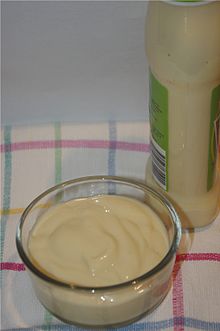
Jar of pale-yellow mayonnaise
ˈmeɪoʊ/) is a thick, creamy sauce often used as a condiment. It is a stable emulsion of oil, egg yolk, and either vinegar or lemon juice, with many options for embellishment with other herbs and spices. Proteins and lecithin in the egg yolk serve as emulsifiers in both mayonnaise and hollandaise sauce. Commercial egg-free alternatives are available for vegans and others who want to avoid animal products and cholesterol, or who are allergic to eggs.

Mayonnaise varies in color, but is often white, cream, or pale yellow. It may range in texture from that of light cream to a thick gel. In countries influenced by French culture, mustard is also a common ingredient, but the addition of mustard turns the sauce into a remoulade with a different flavor and the mustard acts as an additional emulsifier.


Mayonnaise can be made by hand with a mortar and pestle, whisk or fork, or with the aid of an
Making mayonnaise with a whisk
electric mixer or blender. It is made by slowly adding oil to an egg yolk, while whisking vigorously to disperse the oil. The oil and the water in yolks form a base of the emulsion, while lecithin and protein from the yolks are the emulsifiers that stabilize it. Additionally, a bit of a mustard may also be added to sharpen its taste, and further stabilize the emulsion. Mustard contains small amounts of lecithin. If vinegar is added directly to the yolk it can emulsify more oil, thus making more mayonnaise.

For large-scale preparation of mayonnaise where mixing equipment is being employed the process typically begins with the dispersal of eggs, either powdered or liquid, into water. Once emulsified, the remaining ingredients are then added and vigorously mixed until completely hydrated and evenly dispersed. Oil is then added as rapidly as it can be absorbed. Though only a small part of the total, ingredients other than the oil are critical to proper formulation. These must be totally hydrated and dispersed within a small liquid volume, which can cause difficulties including emulsion breakdown during the oil-adding phase. Often a long agitation process is required to achieve proper dispersal/emulsification, presenting one of the trickiest phases of the production process. Though, as technology in the food industry advances, processing has been shortened drastically allowing roughly 1000 liters to be produced in 10 minutes.


Commercial mayonnaise sold in jars originated in Philadelphia in 1907 when Amelia Schlorer decided to start selling her own mayonnaise recipe originally used in salads sold in the family grocery store. Mrs. Schlorer's Mayonnaise was an instant success with local customers and eventually grew into the Schlorer Delicatessen Company. Around the same time in New York City, a family from Vetschau, Germany, at Richard Hellmann's delicatessen on Columbus Avenue, featured his wife's homemade recipe in salads sold in their delicatessen. The condiment quickly became so popular that Hellmann began selling it in "wooden boats" that were used for weighing butter. In 1912, Mrs. Hellmann's mayonnaise was mass-marketed and later was trademarked in 1926 as Hellmann's Blue Ribbon Mayonnaise.


A typical formulation for commercially made mayonnaise (not low fat) can contain as much as 80%
Standard ingredients and tools to make mayonnaise
vegetable oil, usually soybean but sometimes olive oil. Water makes up about 7% to 8% and egg yolks about six percent. Some formulas use whole eggs instead of just yolks. The remaining ingredients include vinegar (4%), salt (1%) and sugar (1%). Low-fat formulas will typically decrease oil content to just 50% and increase water content to about 35%. Egg content is reduced to 4% and vinegar to 3%. Sugar is increased to 1.5% and salt lowered to 0.7%. Gums or thickeners (4%) are added to increase viscosity, improve texture, and ensure a stable emulsion.

There are several ways to prepare mayonnaise, but on average it contains around 700 kilocalories (2,900 kJ) per 100 grams, or 94 calories per tablespoon. This makes mayonnaise a calorically dense food.


There are egg-free versions of mayonnaise available for vegans and others who want to avoid eggs,
Vegan sandwich with egg-free mayo
animal fat, and cholesterol, or who have egg allergies. In the US, these alternatives cannot be labelled as "mayonnaise" because of the FDA's definition of mayonnaise making egg a requirement.

Well-known brands include Nayonaise and Vegenaise in North America, and Plamil Egg Free in the UK.

In August 2015, the United States Food and Drug Administration sent out a warning letter to the San Francisco company Hampton Creek, objecting to the name of their "Just Mayo" product, which is not egg-based and therefore does not meet the U.S. legal definition of "mayonnaise".