Fire up the grill.........
Oil the Food, Not the Grate.......
Oil prevents food from sticking and it adds flavor and moisture, too. Lightly brushing or spraying the food with oil works better than brushing the grate.
Showing posts with label Oil. Show all posts
Showing posts with label Oil. Show all posts
Monday, April 15, 2019


Monday, February 11, 2019
Kitchen Hint of the Day!
Cleaning your Cast Iron Skillet.......
Don’t worry about drying a wet pan with a towel, just place the pan back on a burner on low heat. Allow it to sit until all moisture evaporates from the inside, the outside, and even on handles. (As a bonus, this tip will save your kitchen towels from brown cast iron stains!) Allow pan to cool before handling again. Also a light sheen of little oil in a cast iron pan is a good thing. It will improve the non-stick properties and prevent rust.
Don’t worry about drying a wet pan with a towel, just place the pan back on a burner on low heat. Allow it to sit until all moisture evaporates from the inside, the outside, and even on handles. (As a bonus, this tip will save your kitchen towels from brown cast iron stains!) Allow pan to cool before handling again. Also a light sheen of little oil in a cast iron pan is a good thing. It will improve the non-stick properties and prevent rust.
Monday, January 14, 2019
One of America's Favorites - Sautéed Mushrooms
 |
| Baby bella (portobello) mushrooms being sautéed |
Sautéed mushrooms (French: Champignons sautés au beurre) is a flavorful dish prepared by sautéing edible mushrooms. It is served as a side dish, used as an ingredient in dishes such as coq au vin and beef bourguignon, in foods such as duxelles, as a topping for steaks and toast, and also as a garnish.
Sautéed mushrooms is a common dish prepared by the sautéing of sliced or whole edible mushrooms. Butter is typically used when sautéing the dish, and margarine and cooking oils such as olive oil and canola oil are also used. Clarified butter can be used, as can a mixture of oil and butter. The dish is typically cooked for over a high heat until the mushrooms are browned, with the oil or butter being very hot in a pan before the mushrooms are added. Overcooking may create an inferior dish by the causing the mushrooms to lose moisture and becoming shriveled.
 |
| A steak topped with sautéed shiitake mushrooms |
During the cooking process, the dish can be deglazed with the use of wine, and wine can be used as an ingredient in and of itself without deglazing. The dish can be flavored with lemon juice, various herbs and seasonings, salt and pepper. Additional ingredients such as minced green onions and shallots can also be used. The dish is vegetarian, and may have a meat-like texture.
Sautéed mushrooms is sometimes served as a side dish, and is also used as an ingredient in the preparation of dishes and foods such as beef bourguignon, coq au vin, poulet en cocotte, Poulet Saute Chasseur, soups and stews, sauces, and duxelles, a paste prepared by sautéing mushrooms, onions, shallots, and herbs in butter. Sautéed mushrooms is also used as a topping for cooked steaks and toast, as a side dish meant to specifically accompany steaks, and as a garnish. The dish can serve to add significant flavor to various dishes, in part per the glutamic acid present in the cells of edible mushrooms.
Saturday, January 5, 2019
Kitchen Hint of the Day!
No oil needed...........
Don't add any oil to the pasta water. Some cooks are under the false assumption that a glug of olive oil will keep the strands from clumping. But that's nothing a good stir won't solve, plus oil could leave your pasta too slick for saucing.
Don't add any oil to the pasta water. Some cooks are under the false assumption that a glug of olive oil will keep the strands from clumping. But that's nothing a good stir won't solve, plus oil could leave your pasta too slick for saucing.
Sunday, December 30, 2018
Kitchen Hint of the Day!
Healthy Muffins and Quick Breads............
Prepare muffins and quick breads with less saturated fat and fewer calories. Try swapping out the oil for applesauce in your favorite recipe.
Prepare muffins and quick breads with less saturated fat and fewer calories. Try swapping out the oil for applesauce in your favorite recipe.
Friday, November 16, 2018
Kitchen Hint of the Day!
My neighbor passed this Turkey prep hint along to me........
Rub the turkey with butter or oil - Before putting it in the oven, make sure the skin of the turkey is as dry as possible, and then rub it all over with butter or oil. For even moister meat, place pats of butter under the skin.
Rub the turkey with butter or oil - Before putting it in the oven, make sure the skin of the turkey is as dry as possible, and then rub it all over with butter or oil. For even moister meat, place pats of butter under the skin.
Sunday, July 1, 2018
Kitchen Hint of the Day!
No clump or sticking pasta................
Before draining your pasta after cooking spray you colander with cooking spray or oil. No clumps!
Before draining your pasta after cooking spray you colander with cooking spray or oil. No clumps!
Wednesday, August 23, 2017
Healthy Antipasto Recipes
From the EatingWell website and EatingWell Magazine its Healthy Antipasto Recipes. Healthy and Delicious Antipasto Recipes like; Mediterranean Tuna Antipasto Salad for Two, Roasted Vegetable Antipasto, and Cured or Smoked Salmon Appetizer Platter. Find these and more at the EatingWell website and don't forget to subscribe to the EatngWell Magazine, I just got the latest issue last week! So enjoy and Eat Healthy! http://www.eatingwell.com/
Healthy Antipasto Recipes
 Find healthy, delicious antipasto recipes including antipasto platters and salads. Healthier recipes, from the food and nutrition experts at EatingWell.
Mediterranean Tuna Antipasto Salad for Two
Capers, red onion and fresh herbs give canned tuna and beans a light, fresh taste. Here we serve the tuna salad on a bed of greens. It also works well stuffed into a pita for a sandwich. Give it some extra kick with a pinch of crushed red pepper or cayenne. Serve with olive bread.........
Roasted Vegetable Antipasto
A zesty vinaigrette makes these roasted Brussels sprouts, fennel, carrots and beets pop. If you can't find small carrots, halve larger ones crosswise then quarter lengthwise. Serve this vegetable antipasto as a side dish or appetizer..........
Cured or Smoked Salmon Appetizer Platter
This smoked salmon platter requires little effort but the spread makes a big impression. Served with all the fixings—capers, hard-boiled eggs, cucumber and more—a smoked salmon platter is the ultimate make-ahead appetizer. Lay out everything listed in the ingredients below or just a few of the elements along with an assortment of crackers, cocktail bread and/or sliced baguette..........
* Click the link below to get all the Healthy Antipasto Recipes
http://www.eatingwell.com/recipes/18161/appetizer/antipasto/
Healthy Antipasto Recipes
Mediterranean Tuna Antipasto Salad for Two
Capers, red onion and fresh herbs give canned tuna and beans a light, fresh taste. Here we serve the tuna salad on a bed of greens. It also works well stuffed into a pita for a sandwich. Give it some extra kick with a pinch of crushed red pepper or cayenne. Serve with olive bread.........
Roasted Vegetable Antipasto
A zesty vinaigrette makes these roasted Brussels sprouts, fennel, carrots and beets pop. If you can't find small carrots, halve larger ones crosswise then quarter lengthwise. Serve this vegetable antipasto as a side dish or appetizer..........
Cured or Smoked Salmon Appetizer Platter
This smoked salmon platter requires little effort but the spread makes a big impression. Served with all the fixings—capers, hard-boiled eggs, cucumber and more—a smoked salmon platter is the ultimate make-ahead appetizer. Lay out everything listed in the ingredients below or just a few of the elements along with an assortment of crackers, cocktail bread and/or sliced baguette..........
* Click the link below to get all the Healthy Antipasto Recipes
http://www.eatingwell.com/recipes/18161/appetizer/antipasto/
Friday, May 12, 2017
Kitchen Hints of the Day!
When grilling fish....
* Keep the skin on; it will help prevent your fish from falling apart.
* Brush a light coat of oil on the fish to prevent it from sticking to the grates.
* Choose salmon it's packed with flavor and heart-healthy fats. Flaky fish like cod, sole, and tilapia tend to fall to piece.
* Keep the skin on; it will help prevent your fish from falling apart.
* Brush a light coat of oil on the fish to prevent it from sticking to the grates.
* Choose salmon it's packed with flavor and heart-healthy fats. Flaky fish like cod, sole, and tilapia tend to fall to piece.
Tuesday, April 4, 2017
Kitchen Hint of the Day!
Hold the Oil.....
Remember when cooking Pasta - Adding oil to the water, or to cooked pasta to keep it from sticking will cause your sauce to slip off the noodles. You’ll also end up with greasy pasta.
Remember when cooking Pasta - Adding oil to the water, or to cooked pasta to keep it from sticking will cause your sauce to slip off the noodles. You’ll also end up with greasy pasta.
Thursday, February 16, 2017
Kitchen Hint of the Day!
Thank you to Carol V. for passing this Hint along.....
If measuring out both oil/butter and honey put the oil or butter in your measuring cup first then the honey will slide right out. Makes for an easier clean up.
If measuring out both oil/butter and honey put the oil or butter in your measuring cup first then the honey will slide right out. Makes for an easier clean up.
Thursday, January 26, 2017
Kitchen Hint of the Day!
Mom uses this one all the time........
Rinse measuring cup in hot water before using syrup, oil, etc. Will pour out clean and not stick to cup.
Rinse measuring cup in hot water before using syrup, oil, etc. Will pour out clean and not stick to cup.
Thursday, May 12, 2016
Condiment of the Week - Salad Cream
Salad cream is a creamy, pale yellow condiment based on an emulsion of about 25–50 percent oil in
water, emulsified by egg yolk and acidulated by spirit vinegar. It may include other ingredients such as sugar, mustard, salt, thickener, spices, flavoring and coloring. It was introduced in the United Kingdom in the 1920s, where it is used as a salad dressing and a sandwich spread. Due to the higher cost of ingredients during periods of rationing in the United Kingdom a flavor similar to mayonnaise was achieved in the creation of salad cream.
In the United Kingdom, it has been produced by companies including H. J. Heinz Company and Crosse and Blackwell. Heinz Salad Cream was the first brand developed exclusively for the United Kingdom market. When first created in the Harlesden (London) kitchens of Heinz in 1914 the preparation was done by hand. The jars were packed in straw-lined barrels—12 dozen in each. The work schedule was 180 dozen jars a day, with a halfpenny a dozen bonus if the workforce could beat the target.
Salad cream is available in most supermarkets in Canada, Ireland and Malta, as well as in Australia, where its taste may closely resemble that of "mayonnaise" as it is produced in that country.
Salad cream was not readily available in the United States until the 21st century (though Miracle Whip provided a similar, if thicker alternative); however, with the large population of British expatriates, especially in the Northeast, it is becoming more common. Apart from many expat stores, major retail supermarket chains such as New York-based Wegmans, Maine-based Hannaford[citation needed], Massachusetts-based Stop and Shop[citation needed], Florida-based Publix, California-based Cost Plus World Markets and Michigan-based Meijer now sell salad cream as a regular item. Many supermarkets sell national and store brands of salad dressing which resemble salad cream.
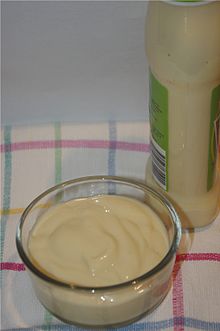 |
| Heinz Salad Cream |
In the United Kingdom, it has been produced by companies including H. J. Heinz Company and Crosse and Blackwell. Heinz Salad Cream was the first brand developed exclusively for the United Kingdom market. When first created in the Harlesden (London) kitchens of Heinz in 1914 the preparation was done by hand. The jars were packed in straw-lined barrels—12 dozen in each. The work schedule was 180 dozen jars a day, with a halfpenny a dozen bonus if the workforce could beat the target.
Salad cream is available in most supermarkets in Canada, Ireland and Malta, as well as in Australia, where its taste may closely resemble that of "mayonnaise" as it is produced in that country.
Salad cream was not readily available in the United States until the 21st century (though Miracle Whip provided a similar, if thicker alternative); however, with the large population of British expatriates, especially in the Northeast, it is becoming more common. Apart from many expat stores, major retail supermarket chains such as New York-based Wegmans, Maine-based Hannaford[citation needed], Massachusetts-based Stop and Shop[citation needed], Florida-based Publix, California-based Cost Plus World Markets and Michigan-based Meijer now sell salad cream as a regular item. Many supermarkets sell national and store brands of salad dressing which resemble salad cream.
Thursday, March 10, 2016
Condiment of the Week - Mayonnaise
Mayonnaise (/ˈmeɪəneɪz/, /ˌmeɪəˈneɪz/ or in AmE also /ˈmæneɪz/, and often abbreviated as mayo /
ˈmeɪoʊ/) is a thick, creamy sauce often used as a condiment. It is a stable emulsion of oil, egg yolk, and either vinegar or lemon juice, with many options for embellishment with other herbs and spices. Proteins and lecithin in the egg yolk serve as emulsifiers in both mayonnaise and hollandaise sauce. Commercial egg-free alternatives are available for vegans and others who want to avoid animal products and cholesterol, or who are allergic to eggs.
Mayonnaise varies in color, but is often white, cream, or pale yellow. It may range in texture from that of light cream to a thick gel. In countries influenced by French culture, mustard is also a common ingredient, but the addition of mustard turns the sauce into a remoulade with a different flavor and the mustard acts as an additional emulsifier.
Mayonnaise can be made by hand with a mortar and pestle, whisk or fork, or with the aid of an
electric mixer or blender. It is made by slowly adding oil to an egg yolk, while whisking vigorously to disperse the oil. The oil and the water in yolks form a base of the emulsion, while lecithin and protein from the yolks are the emulsifiers that stabilize it. Additionally, a bit of a mustard may also be added to sharpen its taste, and further stabilize the emulsion. Mustard contains small amounts of lecithin. If vinegar is added directly to the yolk it can emulsify more oil, thus making more mayonnaise.
For large-scale preparation of mayonnaise where mixing equipment is being employed the process typically begins with the dispersal of eggs, either powdered or liquid, into water. Once emulsified, the remaining ingredients are then added and vigorously mixed until completely hydrated and evenly dispersed. Oil is then added as rapidly as it can be absorbed. Though only a small part of the total, ingredients other than the oil are critical to proper formulation. These must be totally hydrated and dispersed within a small liquid volume, which can cause difficulties including emulsion breakdown during the oil-adding phase. Often a long agitation process is required to achieve proper dispersal/emulsification, presenting one of the trickiest phases of the production process. Though, as technology in the food industry advances, processing has been shortened drastically allowing roughly 1000 liters to be produced in 10 minutes.
Commercial mayonnaise sold in jars originated in Philadelphia in 1907 when Amelia Schlorer decided to start selling her own mayonnaise recipe originally used in salads sold in the family grocery store. Mrs. Schlorer's Mayonnaise was an instant success with local customers and eventually grew into the Schlorer Delicatessen Company. Around the same time in New York City, a family from Vetschau, Germany, at Richard Hellmann's delicatessen on Columbus Avenue, featured his wife's homemade recipe in salads sold in their delicatessen. The condiment quickly became so popular that Hellmann began selling it in "wooden boats" that were used for weighing butter. In 1912, Mrs. Hellmann's mayonnaise was mass-marketed and later was trademarked in 1926 as Hellmann's Blue Ribbon Mayonnaise.
A typical formulation for commercially made mayonnaise (not low fat) can contain as much as 80%
vegetable oil, usually soybean but sometimes olive oil. Water makes up about 7% to 8% and egg yolks about six percent. Some formulas use whole eggs instead of just yolks. The remaining ingredients include vinegar (4%), salt (1%) and sugar (1%). Low-fat formulas will typically decrease oil content to just 50% and increase water content to about 35%. Egg content is reduced to 4% and vinegar to 3%. Sugar is increased to 1.5% and salt lowered to 0.7%. Gums or thickeners (4%) are added to increase viscosity, improve texture, and ensure a stable emulsion.
There are several ways to prepare mayonnaise, but on average it contains around 700 kilocalories (2,900 kJ) per 100 grams, or 94 calories per tablespoon. This makes mayonnaise a calorically dense food.
There are egg-free versions of mayonnaise available for vegans and others who want to avoid eggs,
animal fat, and cholesterol, or who have egg allergies. In the US, these alternatives cannot be labelled as "mayonnaise" because of the FDA's definition of mayonnaise making egg a requirement.
Well-known brands include Nayonaise and Vegenaise in North America, and Plamil Egg Free in the UK.
In August 2015, the United States Food and Drug Administration sent out a warning letter to the San Francisco company Hampton Creek, objecting to the name of their "Just Mayo" product, which is not egg-based and therefore does not meet the U.S. legal definition of "mayonnaise".
 |
| Jar of pale-yellow mayonnaise |
Mayonnaise varies in color, but is often white, cream, or pale yellow. It may range in texture from that of light cream to a thick gel. In countries influenced by French culture, mustard is also a common ingredient, but the addition of mustard turns the sauce into a remoulade with a different flavor and the mustard acts as an additional emulsifier.
Mayonnaise can be made by hand with a mortar and pestle, whisk or fork, or with the aid of an
 |
| Making mayonnaise with a whisk |
For large-scale preparation of mayonnaise where mixing equipment is being employed the process typically begins with the dispersal of eggs, either powdered or liquid, into water. Once emulsified, the remaining ingredients are then added and vigorously mixed until completely hydrated and evenly dispersed. Oil is then added as rapidly as it can be absorbed. Though only a small part of the total, ingredients other than the oil are critical to proper formulation. These must be totally hydrated and dispersed within a small liquid volume, which can cause difficulties including emulsion breakdown during the oil-adding phase. Often a long agitation process is required to achieve proper dispersal/emulsification, presenting one of the trickiest phases of the production process. Though, as technology in the food industry advances, processing has been shortened drastically allowing roughly 1000 liters to be produced in 10 minutes.
Commercial mayonnaise sold in jars originated in Philadelphia in 1907 when Amelia Schlorer decided to start selling her own mayonnaise recipe originally used in salads sold in the family grocery store. Mrs. Schlorer's Mayonnaise was an instant success with local customers and eventually grew into the Schlorer Delicatessen Company. Around the same time in New York City, a family from Vetschau, Germany, at Richard Hellmann's delicatessen on Columbus Avenue, featured his wife's homemade recipe in salads sold in their delicatessen. The condiment quickly became so popular that Hellmann began selling it in "wooden boats" that were used for weighing butter. In 1912, Mrs. Hellmann's mayonnaise was mass-marketed and later was trademarked in 1926 as Hellmann's Blue Ribbon Mayonnaise.
A typical formulation for commercially made mayonnaise (not low fat) can contain as much as 80%
 |
| Standard ingredients and tools to make mayonnaise |
There are several ways to prepare mayonnaise, but on average it contains around 700 kilocalories (2,900 kJ) per 100 grams, or 94 calories per tablespoon. This makes mayonnaise a calorically dense food.
There are egg-free versions of mayonnaise available for vegans and others who want to avoid eggs,
 |
| Vegan sandwich with egg-free mayo |
Well-known brands include Nayonaise and Vegenaise in North America, and Plamil Egg Free in the UK.
In August 2015, the United States Food and Drug Administration sent out a warning letter to the San Francisco company Hampton Creek, objecting to the name of their "Just Mayo" product, which is not egg-based and therefore does not meet the U.S. legal definition of "mayonnaise".
Thursday, February 11, 2016
Kitchen Hint of the Day!
Do not use oil in the water when boiling pasta: It will keep the sauce from sticking to the cooked pasta.
Tuesday, December 29, 2015
Kitchen Hint of the Day!
Rinse a measuring cup in hot water before using syrup, oil, etc. Then it will pour out clean and not stick to cup.
Saturday, June 21, 2014
Kitchen Hints of the Day!
Thank you to Cookie for passing these tips along to share.
Hint #1 -Get into the habit of measuring the oil you use while you cook, rather than just pouring it out of the bottle. It will be much easier to moderate the amount you use.
Hint #2 -Use non-stick cookware so that you don't have to use as much, if any, fat. When sauteing, use a small amount of chicken broth or wine instead of butter or oil.
Hint #1 -Get into the habit of measuring the oil you use while you cook, rather than just pouring it out of the bottle. It will be much easier to moderate the amount you use.
Hint #2 -Use non-stick cookware so that you don't have to use as much, if any, fat. When sauteing, use a small amount of chicken broth or wine instead of butter or oil.
Sunday, May 25, 2014
Kitchen Hint of the Day!
Saute vegetables in broth instead of butter or oil. It's healthier, and you'll have crispy, seasoned vegetables without using heated, oxidized oil (which can cause free-radical damage in the body). Pour in just enough broth to cover the bottom of the pan, and cook, lid on, until tender.
Friday, May 23, 2014
Kitchen Hint of the Day!
While preparing a dish and you find you need more oil in the pan when sautéing, add it in a stream along the edges of the pan so that by the time the oil reaches the ingredient being cooked, it will be heated.
Monday, May 12, 2014
One of America's Favorites - Scrapple
Need a different idea for Breakfast, read on!
Scrapple, also known by the Pennsylvania Dutch name pon haus, is traditionally a mush of pork scraps and trimmings combined with cornmeal and wheat flour, often buckwheat flour, and spices. The mush is formed into a semi-solid congealed loaf, and slices of the scrapple are then pan-fried before serving. Scraps of meat left over from butchering, not used or sold elsewhere, were made into scrapple to avoid waste. Scrapple is best known as a rural American food of the Mid-Atlantic states (Delaware, Maryland, New Jersey, Pennsylvania and Virginia). Scrapple and pon haus are commonly considered an ethnic food of the Pennsylvania Dutch, including the Mennonites and Amish. Scrapple is found in supermarkets throughout the region in both fresh and frozen refrigerated cases.
Scrapple is typically made of hog offal, such as the head, heart, liver, and other trimmings, which are boiled with any bones attached (often the entire head), to make a broth. Once cooked, bones and fat are discarded, the meat is reserved, and (dry) cornmeal is boiled in the broth to make a mush. The meat, finely minced, is returned to the pot and seasonings, typically sage, thyme, savory, black pepper, and others are added. The mush is formed into loaves and allowed to cool thoroughly until set. The proportions and seasoning are very much a matter of the region and the cook's taste.
A few manufacturers have introduced beef and turkey varieties and color the loaf to retain the traditional coloration derived from the original pork liver base. Home recipes for chicken and turkey scrapple are also available.
Scrapple is typically cut into quarter-inch to three-quarter-inch slices and pan-fried until brown to form a crust. It is sometimes first coated with flour. It may be fried in butter or oil and is sometimes deep-fried. Scrapple can also be broiled; this is a good cooking method for those who like their scrapple crisp.
Scrapple is usually eaten as a breakfast side dish. It can be served plain or with either sweet or savory condiments: apple butter, ketchup, jelly, maple syrup, honey, or mustard. The state of Maryland is particularly in favor of scrapple topped with grape jelly. In some regions, such as New England, scrapple is mixed with scrambled eggs and served with toast.[citation needed] In the Philadelphia area, scrapple is sometimes fried and then mashed with fried eggs, horseradish, and ketchup.
Scrapple is arguably the first pork food invented in America. The roots of the culinary traditions that led to the development of scrapple in America have been traced back to pre-Roman Europe. The more immediate culinary ancestor of scrapple was the Low German dish called panhas, which was adapted to make use of locally available ingredients, and it is still called "Pannhaas," "panhoss," "ponhoss," or "pannhas" in parts of Pennsylvania. The first recipes were created by German colonists who settled near Philadelphia and Chester County, Pennsylvania in the 17th and 18th centuries. As a result, scrapple is strongly associated with rural areas surrounding Philadelphia, Baltimore, Washington D.C., eastern Pennsylvania, New Jersey, Maryland, Delaware, eastern Virginia, and the Delmarva Peninsula. Its popularity on the Delmarva Peninsula is celebrated the second weekend of October during the annual "Apple Scrapple Festival" in Bridgeville, Delaware.
In composition, preparation, and taste, scrapple is similar to the white pudding popular in Ireland, Scotland, and parts of England and the spicier Hog's pudding of the West Country of England.
 |
| A plate of scrapple |
Scrapple, also known by the Pennsylvania Dutch name pon haus, is traditionally a mush of pork scraps and trimmings combined with cornmeal and wheat flour, often buckwheat flour, and spices. The mush is formed into a semi-solid congealed loaf, and slices of the scrapple are then pan-fried before serving. Scraps of meat left over from butchering, not used or sold elsewhere, were made into scrapple to avoid waste. Scrapple is best known as a rural American food of the Mid-Atlantic states (Delaware, Maryland, New Jersey, Pennsylvania and Virginia). Scrapple and pon haus are commonly considered an ethnic food of the Pennsylvania Dutch, including the Mennonites and Amish. Scrapple is found in supermarkets throughout the region in both fresh and frozen refrigerated cases.
Scrapple is typically made of hog offal, such as the head, heart, liver, and other trimmings, which are boiled with any bones attached (often the entire head), to make a broth. Once cooked, bones and fat are discarded, the meat is reserved, and (dry) cornmeal is boiled in the broth to make a mush. The meat, finely minced, is returned to the pot and seasonings, typically sage, thyme, savory, black pepper, and others are added. The mush is formed into loaves and allowed to cool thoroughly until set. The proportions and seasoning are very much a matter of the region and the cook's taste.
A few manufacturers have introduced beef and turkey varieties and color the loaf to retain the traditional coloration derived from the original pork liver base. Home recipes for chicken and turkey scrapple are also available.
Scrapple is typically cut into quarter-inch to three-quarter-inch slices and pan-fried until brown to form a crust. It is sometimes first coated with flour. It may be fried in butter or oil and is sometimes deep-fried. Scrapple can also be broiled; this is a good cooking method for those who like their scrapple crisp.
Scrapple is usually eaten as a breakfast side dish. It can be served plain or with either sweet or savory condiments: apple butter, ketchup, jelly, maple syrup, honey, or mustard. The state of Maryland is particularly in favor of scrapple topped with grape jelly. In some regions, such as New England, scrapple is mixed with scrambled eggs and served with toast.[citation needed] In the Philadelphia area, scrapple is sometimes fried and then mashed with fried eggs, horseradish, and ketchup.
 |
| Scrapple sandwich |
Scrapple is arguably the first pork food invented in America. The roots of the culinary traditions that led to the development of scrapple in America have been traced back to pre-Roman Europe. The more immediate culinary ancestor of scrapple was the Low German dish called panhas, which was adapted to make use of locally available ingredients, and it is still called "Pannhaas," "panhoss," "ponhoss," or "pannhas" in parts of Pennsylvania. The first recipes were created by German colonists who settled near Philadelphia and Chester County, Pennsylvania in the 17th and 18th centuries. As a result, scrapple is strongly associated with rural areas surrounding Philadelphia, Baltimore, Washington D.C., eastern Pennsylvania, New Jersey, Maryland, Delaware, eastern Virginia, and the Delmarva Peninsula. Its popularity on the Delmarva Peninsula is celebrated the second weekend of October during the annual "Apple Scrapple Festival" in Bridgeville, Delaware.
In composition, preparation, and taste, scrapple is similar to the white pudding popular in Ireland, Scotland, and parts of England and the spicier Hog's pudding of the West Country of England.
Subscribe to:
Posts (Atom)