Showing posts with label Condiments. Show all posts

Thursday, May 26, 2016

Condiment of the Week - Salsa (sauce)

Salsa is the Italian and Spanish term for sauce, and in English-speaking countries usually refers to the
Salsa
sauces typical of Mexican cuisine known as salsa picante, particularly those used as dips.

Salsa is often a tomato-based sauce or dip which is heterogeneous and includes additional components such as onions, chilies, beans, corn, and various spices. They are typically piquant, ranging from mild to extremely hot.


Mexican salsas were traditionally produced using the mortar and pestle-like molcajete, although blenders are now more commonly used. The Maya made salsa also, using a mortar and pestle. Well-known salsas include:

* Salsa roja, "red sauce", is used as a condiment in Mexican and Southwestern (U.S.) cuisines; usually includes cooked tomatoes, chili peppers, onion, garlic, and fresh cilantro (coriander).
* Pico de gallo ("rooster's beak"), also known as salsa fresca ("fresh sauce"), salsa picada ("chopped sauce"), or salsa mexicana ("Mexican sauce"), is made with raw tomatoes, lime juice, chilies, onions, cilantro leaves, and other coarsely chopped raw ingredients.
* Salsa cruda, "raw sauce", is an uncooked mixture of chopped tomatoes, onions, jalapeño chilies, and cilantro, or coriander leaf.
* Salsa verde, "green sauce", in Mexican versions, is made with tomatillos, usually cooked. The Italian version is made with herbs.
* Salsa negra, "black sauce" is a Mexican sauce made from dried chilies, oil, and garlic.
* Salsa taquera, "taco sauce": Made with tomatillos and morita chili
* Salsa criolla is a South American salsa with a sliced-onion base.
* Salsa ranchera, "ranch-style sauce": Made with roasted tomatoes, various chilies, and spices, it typically is served warm, and possesses a thick, soupy quality. Though it contains none, it imparts a characteristic flavor reminiscent of black pepper.
* Salsa brava, "wild sauce", is a mildly spicy sauce made with tomato, garlic, onion, and vinegar, often flavored with paprika. On top of potato wedges, it makes the dish patatas bravas, typical of tapas bars in Spain.
* Guacamole is thicker than a sauce and generally used as a dip; it refers to any sauce where the main ingredient is avocado.
* Mole (Spanish pronunciation: [ˈmole]) is a Mexican sauce made from chilies mixed with spices, unsweetened chocolate, almonds, and other ingredients.
* Mango salsa is a spicy-sweet sauce made from mangoes, used as a topping for nachos. It is often
Mango pineapple salsa 
also used as a garnish on grilled chicken or grilled fish due to the sauce's gamut of complementary flavors.
* Pineapple salsa is a spicy and sweet sauce made from pineapples, used as an alternative to the mango salsa.
* Chipotle salsa is a smoky, spicy sauce made from smoked jalapeño chilies, tomatoes, garlic and spices.
* Habanero salsa is an extremely spicy salsa, where the piquancy comes from habanero chilies.
* Corn salsa is a chunky salsa made with sweetcorn and other ingredients, such as onions, and chiles (either poblano, bell chilies, and/or jalapeños), made popular by the burrito chains for burritos, tacos, and quesadillas.
* Carrot salsa is made with carrots as the base.

There are many other salsas, both traditional and nouveau, some are made with mint, pineapple, or mango.

Outside of Mexico and Central America, the following salsas are common to each of the following regions; in Argentina and the Southern Cone, chimichurri sauce is common. Chimichurri is "a spicy vinegar-parsley sauce that is the salsa (and leading condiment) in Argentina and Uruguay, served with grilled meat. It is made of chopped fresh parsley and onion, seasoned with garlic, oregano, salt, cayenne chilies and black pepper and bound with oil and vinegar." In Costa Rica, dishes are prepared with salsa Lizano, a thin, smooth, light brown sauce. In Cuba and the Caribbean, a typical salsa is mojo. Unlike the tomato-based salsas, mojo typically consists of olive oil, garlic, and citrus juice, and is used both to marinate meats and as a dipping sauce. In Peru, a traditional salsa is peri peri or piri piri sauce: "The national condiment of Peru, peri-peri sauce is made in medium to hot levels of spiciness—the more chili, or the hotter variety of chile used, the hotter the sauce. Original peri-peri uses the African bird’s eye chili (the African word for the chili is peri-peri). Milder sauces may use only cayenne and serrano chilies. To a base of vinegar and oil, garlic and lemon juice are added, plus other seasonings, which often include paprika or tomato paste for flavor and color, onions and herb—each company has its own recipe. It is also used as a cooking.


Most jarred, canned, and bottled salsa and picante sauces sold in the United States in grocery stores
An American, home-prepared version of pico de gallo/salsa fresca
are forms of salsa cruda or pico de gallo, and typically have a semi-liquid texture. To increase their shelf lives, these salsas have been cooked to a temperature of 175 °F (79 °C). Some have added vinegar, and some use pickled peppers instead of fresh ones. Tomatoes are strongly acidic by nature, which, along with the heat processing, is enough to stabilize the product for grocery distribution.

Picante sauce of the American type is often thinner in consistency than what is labelled as "salsa". Picante is a Spanish adjective meaning "piquant", which derives from picar ("to sting"), referring to the feeling caused by salsas on one's tongue.

Many grocery stores in the United States and Canada also sell "fresh" refrigerated salsa, usually in plastic containers. Fresh salsa is usually more expensive and has a shorter shelf life than canned or jarred salsa. It may or may not contain vinegar.

Taco sauce is a condiment sold in American grocery stores and fast food Tex-Mex outlets. Taco sauce is similar to its Mexican counterpart in that it is smoothly blended, having the consistency of thin ketchup. It is made from tomato paste instead of whole tomatoes and lacks the seeds and chunks of vegetables found in picante sauce.

While some salsa fans do not consider jarred products to be real salsa cruda, their widespread availability and long shelf life have been credited with much of salsa's enormous popularity in states outside of the southwest, especially in areas where salsa is not a traditional part of the cuisine. In 1992, the dollar total of salsa sales in the United States exceeded those of tomato ketchup.


The World Health Organization says care should be taken in the preparation and storage of salsas and any other types of sauces, since many raw-served varieties can act as growth media for potentially dangerous bacteria, especially when unrefrigerated.

In 2002 a study by the University of Texas–Houston, found sauces contaminated with E. coli in:

* 66% of the sauces from restaurants tested in Guadalajara, Jalisco
* 40% of those from restaurants tested in Houston, Texas
In 2010 the CDC reported that 1 in 25 food borne illnesses between 1998 and 2008 was traced back to restaurant sauces (careless prepared or stored).

A 2010 paper on salsa food hygiene described refrigeration as "the key to safe" sauces. This study also found that fresh lime juice and fresh garlic (but not powdered garlic) would prevent the growth of bacteria.




Thursday, May 12, 2016

Condiment of the Week - Salad Cream

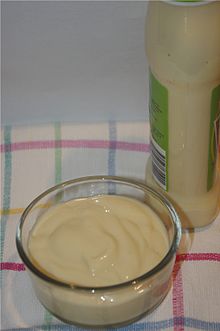
Salad cream is a creamy, pale yellow condiment based on an emulsion of about 25–50 percent oil in
Heinz Salad Cream
water, emulsified by egg yolk and acidulated by spirit vinegar. It may include other ingredients such as sugar, mustard, salt, thickener, spices, flavoring and coloring. It was introduced in the United Kingdom in the 1920s, where it is used as a salad dressing and a sandwich spread. Due to the higher cost of ingredients during periods of rationing in the United Kingdom a flavor similar to mayonnaise was achieved in the creation of salad cream.


In the United Kingdom, it has been produced by companies including H. J. Heinz Company and Crosse and Blackwell. Heinz Salad Cream was the first brand developed exclusively for the United Kingdom market. When first created in the Harlesden (London) kitchens of Heinz in 1914 the preparation was done by hand. The jars were packed in straw-lined barrels—12 dozen in each. The work schedule was 180 dozen jars a day, with a halfpenny a dozen bonus if the workforce could beat the target.

Salad cream is available in most supermarkets in Canada, Ireland and Malta, as well as in Australia, where its taste may closely resemble that of "mayonnaise" as it is produced in that country.

Salad cream was not readily available in the United States until the 21st century (though Miracle Whip provided a similar, if thicker alternative); however, with the large population of British expatriates, especially in the Northeast, it is becoming more common. Apart from many expat stores, major retail supermarket chains such as New York-based Wegmans, Maine-based Hannaford[citation needed], Massachusetts-based Stop and Shop[citation needed], Florida-based Publix, California-based Cost Plus World Markets and Michigan-based Meijer now sell salad cream as a regular item. Many supermarkets sell national and store brands of salad dressing which resemble salad cream.


Thursday, April 14, 2016

Condiment of the Week - Piccalilli

Mustard piccalilli

Piccalilli is an English interpretation of Indian pickles, a relish of chopped pickled vegetables and spices; regional recipes vary considerably.


British piccalilli contains various vegetables – invariably cauliflower and vegetable marrow – and seasonings of mustard and turmeric. A more finely chopped variety "sandwich piccalilli" is also available from major British supermarkets. It is used as an accompaniment to foods such as sausages, bacon, eggs, toast, cheese, and tomatoes. It is similar to a sweet pickle such as Branston Pickle, except it is tangier and slightly less sweet, colored bright yellow (using turmeric) rather than brown, and the chunks are larger. It is usually used to accompany a dish on a plate rather than as a bread spread. It is popular as a relish with cold meats such as ham and brawn, and with a ploughman's lunch. It is produced both commercially and domestically, the latter product being a traditional mainstay of Women's Institute and farmhouse product stalls.


In the Northeastern United States, commercial piccalillis are based on diced sweet peppers, either red
 Piccalilli on toast
or green. This style is somewhat similar to sweet pepper relish, with the piccalilli being distinguished by having a darker red or green color and like British piccalilli, the chunks are larger and it is slightly sweeter. It is a popular topping on such foods as hamburgers and hot dogs. Traditional, British-style yellow piccalilli is also available.

In the Midwestern United States, commercial piccalillis are based on finely chopped gherkins; bright green and on the sweet side, they are often used as a condiment for Chicago-style hot dogs. This style is sometimes called "neon relish".

In the Southern United States, piccalilli is not commonly served. In its place, chow-chow, a relish with a base of chopped green (unripe) tomatoes is offered. This relish may also include onions, bell peppers, cabbage, green beans and other vegetables. While not exactly similar to other piccalillis, chow-chow is often called as such and the terms may be used interchangeably. Piccalilli is uncommon in the Western United States.


A far spicier variant of piccalilli comes from the former Dutch colony of Suriname, where traditional British piccalilli is mixed with a sambal made of garlic and yellow Madame Jeanette peppers. This piccalilli is often homemade but can also be bought in jars in Dutch corner shops. Whilst Surinamese piccalilli is similar in appearance to ordinary piccalilli, the taste is much spicier.


Thursday, April 7, 2016

Condiment of the Week - Pesto

Pesto (Italian pronunciation: [ˈpesto]) or, in extenso, pesto alla genovese (Italian pronunciation:
Basil pesto
[ˈpesto ˈaːlla genoˈveːse]), is a sauce originating in Genoa, the capital city of Liguria, Northern Italy. It traditionally consists of crushed garlic, European pine nuts, coarse salt, basil, Parmigiano-Reggiano (Parmesan cheese) and pecorino sardo (cheese made from sheep's milk), all blended with olive oil.


Pesto is traditionally prepared in a marble mortar with a wooden pestle. First, garlic and pine nuts are placed in the mortar and reduced to a cream, then the washed and dried basil leaves are added with coarse salt and ground to a creamy consistency. Only then is a mix of Parmigiano-Reggiano and Pecorino added. To help incorporate the cheese a little extra-virgin olive oil is added. In a tight jar (or simply in an air-tight plastic container), covered by a layer of extra-virgin olive oil, pesto can last in the refrigerator up to a week, and can be frozen for later use.


Pesto is commonly used on pasta, traditionally with mandilli de sæa ("silk handkerchiefs" in the
Linguine with basil pesto
Genoese dialect), trofie or trenette. Potatoes and string beans are also traditionally added to the dish, boiled in the same pot in which the pasta has been cooked.

It is sometimes used in minestrone. Pesto is sometimes served with sliced beef tomatoes and sliced boiled potatoes.


Pesto comes in a variety of recipes, some traditional and some modern, as the very noun pesto is a generic term for anything that is made by pounding.

Pesto alla genovese, the quintessential pesto recipe, is made with Genovese basil, coarse salt, garlic, Ligurian extra virgin olive oil (Taggiasco), European pine nuts (sometimes toasted) and a grated cheese like Parmigiano Reggiano or Grana Padano and pecorino sardo or pecorino romano.

A slightly different version of this sauce exists in Provence, where it is known as pistou. In contrast with pesto alla genovese, pistou is generally made with olive oil, basil and garlic only: while cheese may be added, usually no nuts are included in a traditional pistou because no pine trees grow there to provide the nuts. Pistou is used in the typical soupe au pistou, a hearty vegetable soup with pistou flavour. The sauce did not originally contain basil, however; instead, cheese and olive oil were the main constituents.

Sometimes almonds are used instead of pine nuts, and sometimes mint leaves are mixed in with the
Fettuccine with Pesto alla genovese
basil leaves. It has been pointed out that pesto is essentially a combination of flavourful leaves, oily nuts, hard cheese, olive oil, garlic, salt and lemon juice; any ingredients meeting this description can produce a pesto-like condiment.

Pesto alla siciliana, sometimes called pesto rosso (red pesto), is a sauce from Sicily similar to pesto alla genovese but with the addition of tomato, almonds instead of pine nuts, and much less basil. Pesto alla calabrese is a sauce from Calabria consisting of (grilled) bell peppers, black pepper and more; these ingredients give it a distinctively spicy taste.

Outside Italy, the household name pesto has been used for all sorts of cold sauces or dips, mostly without any of the original ingredients: arugula (instead of or in addition to basil), black olives, lemon peel, coriander, or mushrooms. In more northern countries, ramson leaves are sometimes used instead of basil. In the 19th century, Genovese immigrants to Argentina brought pesto recipes with them. A Peruvian variety, known as "tallarines verdes" (meaning green noodles, from Italian tagliarini), is slightly creamier, lacks pine nuts (because of their rarity and prohibitive cost in Peru), may use spinach and vegetable oil (in place of olive oil), and is sometimes served with roasted potatoes and sirloin steak.

Vegan variations of pesto can include mixes of fresh basil, nuts such as walnut or pine nut, olive oil, and the addition of miso paste and nutritional yeast to provide additional flavor enhancement to the dish.


Thursday, March 31, 2016

Condiment of the Week - Olive Oil

Olive oil is a fat obtained from the olive (the fruit of Olea europaea; family Oleaceae), a traditional
Extra-virgin olive oil
tree crop of the Mediterranean Basin. The oil is produced by pressing whole olives and is commonly used in cooking, cosmetics, pharmaceuticals, and soaps, and as a fuel for traditional oil lamps. Olive oil is used throughout the world and is often associated with Mediterranean countries. Adulteration of olive oil is widespread, with involvement by organised crime.


There are many different olive varieties or olives, each with a particular flavor, texture, and shelf life that make them more or less suitable for different applications such as direct human consumption on bread or in salads, indirect consumption in domestic cooking or catering, or industrial uses such as animal feed or engineering applications.


In 2013, world production of virgin olive oil was 2.8 million tonnes, a 20% decrease from the 2012 world production of 3.5 million tonnes. Spain produced 1.1 million tonnes or 39% of world production in 2013. 75% of Spain's production derives from the region of Andalucía, particularly within Jaén province which produces 70% of olive oil in Spain. In the town of Villacarrillo, Jaén, is the world’s largest olive oil mill capable of processing 2,500 tons of olives per day.

Although Italy is a net importer of olive oil, it produced 442,000 tonnes in 2013 or 16% of the world's production. Major Italian producers are known as "Città dell'Olio", "oil cities"; including Lucca, Florence and Siena, in Tuscany. The largest production, however, is harvested in Apulia and Calabria. Greece accounted for 11% of world production in 2013.

Australia now produces a substantial amount of olive oil. Many Australian producers only make premium oils, while a number of corporate growers operate groves of a million trees or more and produce oils for the general market. Australian olive oil is exported to Asia, Europe and the United States.

In North America, Italian and Spanish olive oils are the best-known, and top-quality extra-virgin olive oil from Italy, Spain, Portugal and Greece are sold at high prices, often in prestige packaging. A large part of U.S. olive oil imports come from Italy, Spain, and Turkey.

The United States produces olive oil in California, Arizona, and Texas.


Olive oil is the main cooking oil in countries surrounding the Mediterranean.
A bottle of Italian olive oil

Extra virgin olive oil is mostly used as a salad dressing and as an ingredient in salad dressings. It is also used with foods to be eaten cold. If uncompromised by heat, the flavor is stronger. It also can be used for sautéing.

The higher the temperature to which the olive oil is heated, the higher the risk of compromising its taste. When extra virgin olive oil is heated above 210–216 °C (410–421 °F), depending on its free fatty acid content, the unrefined particles within the oil are burned. This leads to deteriorated taste. Also, the pronounced taste of extra virgin olive oil is not a taste most people like to associate with their deep fried foods. Refined olive oils are perfectly suited for deep frying foods and should be replaced after several uses.

Choosing a cold-pressed olive oil can be similar to selecting a wine. The flavor of these oils varies considerably and a particular oil may be more suited for a particular dish.

An important issue often not realized in countries that do not produce olive oil is that the freshness makes a big difference. A very fresh oil, as available in an oil producing region, tastes noticeably different from the older oils available elsewhere. In time, oils deteriorate and become stale. One-year-old oil may be still pleasant to the taste, but it is less fragrant than fresh oil. After the first year, olive oil should be used for cooking, not for foods to be eaten cold, like salads.

The taste of the olive oil is influenced by the varietals used to produce the oil and by the moment when the olives are harvested and ground (less ripe olives give more bitter and spicy flavors – riper olives give a sweeter sensation in the oil).


Olive oil is also a natural and safe lubricant, and can be used to lubricate machinery that is used within the kitchen (grinders, blenders, cookware, etc.) It can also be used for illumination (oil lamps) or as the base for soaps and detergents. Some cosmetics also use olive oil as their base.

Olive oil may be used in soap making, as lamp oil, a lubricant, or as a substitute for machine oil.
Olive oil has also been used as both solvent and ligand in the synthesis of cadmium selenide quantum dots.
In one study, monounsaturated fats such as from olive oil benefited mood, decreased anger, and increased physical activity.


Thursday, March 3, 2016

Condiment of the Week - Ketchup

Ketchup, or catsup, is a table sauce. Traditionally, different recipes featured ketchup made of egg
Homemade tomato ketchup
white, mushrooms, oysters, mussels, walnuts, or other foods, but in modern times the term without modification usually refers to tomato ketchup, often called tomato sauce in the UK. It is a sweet and tangy sauce, typically made from tomatoes, a sweetener, vinegar, and assorted seasonings and spices. Seasonings vary by recipe, but commonly include onions, allspice, cloves, cinnamon, garlic, and sometimes celery. Heinz tomato ketchup is the market leader, with an 82% market share in the UK and 60% share in the US.

Tomato ketchup is often used as a condiment with various dishes that are usually served hot, including chips/fries, hamburgers, sandwiches, hot dogs, eggs, and grilled or fried meat. Ketchup is sometimes used as a basis or ingredient for other sauces and dressings. Ketchup is also used as a flavoring for things such as potato chips, and this variety of chips is one of the most popular flavors in Canada. This flavor of potato chip has also been offered in the U.S. as recently as September 2014.


In the 17th century, the Chinese mixed a concoction of pickled fish and spices and called it (in the Amoy dialect) kôe-chiap or kê-chiap.  Mandarin Chinese guī zhī, Cantonese gwai1 zap1) meaning the brine of pickled fish  or shellfish. By the early 18th century, the table sauce had made it to the Malay states (present day Malaysia and Singapore), where it was discovered by English explorers. The Indonesian-Malay word for the sauce was kecap (pronounced "kay-chap"). That word evolved into the English word "ketchup". English settlers took ketchup with them to the American colonies.


Mushroom ketchup
In the United Kingdom, preparations of ketchup were historically and originally prepared with
Homemade mushroom ketchup 
mushroom as a primary ingredient, rather than tomato. Ketchup recipes begin to appear in British and then American cookbooks in the 18th century. In a 1742 London cookbook the fish sauce has already taken on a very British flavor, with the addition of shallots and mushroom. The mushrooms soon became a main ingredient, and from 1750 to 1850 the word ketchup began to mean any number of thin dark sauces made of mushrooms or even walnuts. In the United States, mushroom ketchup dates back to at least 1770, and was prepared by British colonists in "English speaking colonies in North America". In contemporary times, mushroom ketchup is available in the UK, although it is not a commonly used condiment.


Tomato Ketchup
Many variations of ketchup were created, but the tomato-based version did not appear until about a century after other types. By 1801, a recipe for tomato ketchup was created by Sandy Addison and was later printed in an American cookbook, the Sugar House Book.

1 - Get [the tomatoes] quite ripe on a dry day, squeeze them with your hands till reduced to a pulp,
Tomato ketchup with additional condiments
then put half a pound of fine salt to one hundred tomatoes, and boil them for two hours.
2 - Stir them to prevent burning.
3 - While hot press them through a fine sieve, with a silver spoon till nought but the skin remains, then add a little mace, 3 nutmegs, allspice, cloves, cinnamon, ginger, and pepper to taste.
4 - Boil over a slow fire till quite thick, stir all the time.
5 - Bottle when cold.
6 - One hundred tomatoes will make four or five bottles and keep good for two or three years.
This early recipe for "Tomata Catsup" from 1817 still has the anchovies that betray its fish-sauce ancestry:

1 - Gather a gallon of fine, red, and full ripe tomatas; mash them with one pound of salt.
2 - Let them rest for three days, press off the juice, and to each quart add a quarter of a pound of anchovies, two ounces of shallots, and an ounce of ground black pepper.
3 - Boil up together for half an hour, strain through a sieve, and put to it the following spices; a quarter of an ounce of mace, the same of allspice and ginger, half an ounce of nutmeg, a drachm of coriander seed, and half a drachm of cochineal.
4 - Pound all together; let them simmer gently for twenty minutes, and strain through a bag: when cold, bottle it, adding to each bottle a wineglass of brandy. It will keep for seven years.
By the mid-1850s, the anchovies had been dropped.

James Mease published another recipe in 1812. In 1824, a ketchup recipe using tomatoes appeared in The Virginia Housewife (an influential 19th-century cookbook written by Mary Randolph, Thomas Jefferson's cousin). American cooks also began to sweeten ketchup in the 19th century.

As the century progressed, tomato ketchup began its ascent in popularity in the United States.
Tomatoes and tomato ketchup
Ketchup was popular long before fresh tomatoes were. Many Americans continued to question whether it was safe to eat raw tomatoes. However, they were much less hesitant to eat tomatoes as part of a highly processed product that had been cooked and infused with vinegar and spices.

Tomato ketchup was sold locally by farmers. Jonas Yerkes is credited as the first American to sell tomato ketchup in a bottle. By 1837, he had produced and distributed the condiment nationally. Shortly thereafter, other companies followed suit. F. & J. Heinz launched their tomato ketchup in 1876. Heinz tomato ketchup was advertised: "Blessed relief for Mother and the other women in the household!", a slogan which alluded to the lengthy and onerous process required to produce tomato ketchup in the home. With industrial ketchup production and a need for better preservation there was a great increase of sugar in ketchup, leading to our modern sweet and sour formula.

The Webster's Dictionary of 1913 defined ‘catchup’ as: “table sauce made from mushrooms, tomatoes, walnuts, etc.

Modern ketchup emerged in the early years of the 20th century, out of a debate over the use of sodium benzoate as a preservative in condiments. Harvey W. Wiley, the "father" of the Food and Drug Administration in the US, challenged the safety of benzoate which was banned in the 1906 Pure Food and Drug Act. In response, entrepreneurs including Henry J. Heinz, pursued an alternative recipe that eliminated the need for that preservative.

Prior to Heinz (and his fellow innovators), commercial tomato ketchups of that time were watery and thin, in part due to the use of unripe tomatoes, which were low in pectin. They had less vinegar than modern ketchups; by pickling ripe tomatoes, the need for benzoate was eliminated without spoilage or degradation in flavor. But the changes driven by the desire to eliminate benzoate also produced changes that some experts believe were key to the establishment of tomato ketchup as the dominant American condiment.


In fast food outlets, ketchup is often dispensed in small packets. Diners tear the side or top and
Ketchup packets
squeeze the ketchup out of the ketchup packets. In 2011, Heinz began offering a new measured-portion package, called the "Dip and Squeeze" packet, which allowed the consumer to either tear the top off the package and squeeze the contents out, as with the traditional packet, or, in the alternative, tear the front off the package and use the package as a dip cup of the type often supplied with certain entreés.

Previously, fast food outlets dispensed ketchup from pumps into paper cups. This method has made a resurgence in the first decade of the 21st century with cost and environmental concerns over the increasing use of individual packets.

In October 2000, Heinz introduced colored ketchup products called EZ Squirt, which eventually included green (2000), purple (2001), pink (2002), orange (2002), teal (2002), and blue (2003). These products were made by adding food coloring to the traditional ketchup. As of January 2006 these products have been discontinued.


Monday, August 25, 2014

Pass the Mustard, the Sweet Hot Stone Ground Mustard!


If you're looking for a good Mustard, I've found one for you! About 3 months ago I purchased a bottle of Kroger Private Selection Sweet Hot Stone Ground Mustard. This is the best Mustard we've ever had. It's just as the name says; it's got a Sweet hint to it and a bit of a bite Hot to it. Then being Stone Ground it has the Mustard Seeds in it that just pop with flavor as your eating it! It's especially good on Pork dishes. So if you're looking for something to add flavor to your sandwich or recipe grab a bottle of Kroger Private Selection Sweet Hot Stone Ground Mustard.