Showing posts with label chives. Show all posts

Monday, February 4, 2019

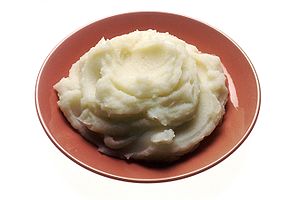
One of America's Favorites - Mashed Potatoes

Mashed potato (British English) or mashed potatoes (American English and Canadian English), colloquially known as mash, is a dish prepared by mashing boiled, peeled potatoes. Milk and butter are frequently used in preparation and it is frequently whipped at the end. The dish is usually a side dish to meat and/or vegetables. The closely related smashed potatoes dish is made with unskinned potatoes and it is hand mashed and not whipped.

Mashed Potatoes

Recipes for making the dish started appearing in 1747 with an entry in The Art of Cookery by Hannah Glasse. Dehydrated and frozen mashed potatoes are available in many supermarkets.

Mashed potato may be used as an intermediary ingredient for other dishes such as dumplings and gnocchi, in which case the potatoes may be baked or boiled, and may or may not have dairy or seasoning added.


The use of "floury" types of potatoes is recommended, although "waxy" potatoes are sometimes used for a different texture. There are a multitude of "floury" types, but the most commonly known include russet, golden wonder, and red rascal potatoes. Butter, vegetable oil, milk and/or cream are usually added to improve flavor and texture, and the potatoes are seasoned with salt, pepper, and any other desired herbs and spices. Popular ingredients and seasonings include: garlic, cheese, bacon bits, sour cream, crisp onion or spring onion, caramelised onion, mayonnaise, mustard, horseradish, spices such as nutmeg, and chopped herbs such as parsley.

One French variation adds egg yolk for pommes duchesse or Duchess potatoes; piped through a pastry tube into wavy ribbons and rosettes, brushed with butter and lightly browned. Pomme purée (potato puree) uses considerably more butter than normal mashed potato - up to one part butter for every two parts potato. In low-calorie or non-dairy variations, milk, cream and butter may be replaced by soup stock or broth. Aloo Bharta, an Indian sub-continent variation, uses chopped onions, mustard (oil, paste or seeds), chili pepper, coriander leaves and other spices.


Mashed potato can be served as a side dish, and is often served with sausages in the British Isles,
Mashed potato served with Frankfurter Rippchen,
sauerkraut and mustard
where they are known as bangers and mash. Mashed potato can be an ingredient of various other dishes, including shepherd's and cottage pie, pierogi, colcannon, dumplings, potato pancakes, potato croquettes and gnocchi. Particularly runny mashed potatoes are called mousseline potatoes.

In the United Kingdom, the cold mashed potato is mixed with fresh eggs and then fried until crisp to produce the potato cake. This dish is thought to have originated in Cornwall and is a popular breakfast item. When instead combined with meat and other leftover vegetables, the fried dish is known as bubble and squeak.

A popular accompaniment to mashed potatoes in the United States is gravy. The most common forms of gravy paired with mashed potatoes are beef gravy or turkey gravy, though vegetable gravy is becoming more common as the vegetarian and vegan trends see a rise in popularity.

A potato masher is a utensil which can be used to prepare the potatoes, as is a potato ricer. They may also be whipped with an electric hand mixer, or with sufficient boiling, can be mashed effectively with a durable wooden spoon and brute force.


Monday, April 24, 2017

One of America's Favorites - The Baked Potato

A baked potato with butter

A baked potato, or jacket potato, is a potato that has been baked for eating. When well cooked, a baked potato has a fluffy interior and a crisp skin. It may be served with fillings and condiments such as butter, cheese or ham. Potatoes can be baked in a conventional gas or electric oven, a convection oven, a microwave oven, on a barbecue grill, or on/in an open fire. Some restaurants use special ovens designed specifically to cook large numbers of potatoes, then keep them warm and ready for service.

Prior to cooking, the potato should be scrubbed clean, washed and dried with eyes and surface blemishes removed, and basted with oil (usually Olive oil) or butter and/or salt. Pricking the potato with a fork or knife allows steam to escape during the cooking process. Potatoes cooked in a microwave oven without pricking the skin might split open due to built up internal pressure from unvented steam. It takes between one and two hours to bake a large potato in a conventional oven at 200 °C (392 °F). Microwaving takes from six to twelve minutes depending on oven power and potato size, but does not generally produce a crisp skin. Some recipes call for use of both a microwave and a conventional oven, with the microwave being used to vent most of the steam prior to the cooking process.

Some varieties of potato such as Russet and King Edward potatoes are more suitable for baking than others, owing to their size and consistency.

Wrapping the potato in aluminium foil before cooking in a standard oven will help to retain moisture, while leaving it unwrapped will result in a crisp skin. When cooking over an open fire or in the coals of a barbecue, it may require wrapping in foil to prevent burning of the skin. A potato buried directly in coals of a fire cooks very nicely, with a mostly burned and inedible skin. A baked potato is fully cooked when its internal temperature reaches 99 °C (210 °F).

Once a potato has been baked, some people discard the skin and eat only the softer and moister interior, while others enjoy the taste and texture of the crisp skin. Potatoes baked in their skins may lose between 20 and 40% of their vitamin C content because heating in air is slow and vitamin inactivation can continue for a long time. Small potatoes bake more quickly than large ones and therefore retain more of their vitamin C. Despite the popular misconception that potatoes are fattening, baked potatoes can be used as part of a healthy diet.


Baked potato and sweet potato, with kale

Some people bake their potatoes and then scoop out the interior, leaving the skin as a shell. The white interior flesh can then be mixed with various other food items such as cheese, butter, or bacon bits. This mixture is then spooned back into the skin shells and they are replaced in the oven to warm through. In America these are known variously as loaded potato skins, filled potatoes and twice baked potatoes. In Great Britain, toppings or fillings tend to be more varied than they are in America: baked beans, curried chicken, tuna, and prawn fillings are popular, and in Scotland even haggis is used as a filling for jacket potatoes.

A variation is Hasselback potatoes, where the potato is cut into very thin slices almost down the bottom, so that the potato still holds together, and is then baked in the oven, occasionally scalloped with cheese. The proper noun "Hasselback" refers to the luxurious Hasselbacken hotel and restaurant in Stockholm which originated this dish.


Many restaurants serve baked potatoes with sides such as butter, sour cream, chives, shredded cheese, and bacon bits. These potatoes can be a side item to a steak dinner, or some similar entree. Sides are usually optional and customers can order as many or as few as they wish.

Large, stuffed baked potatoes may be served as an entree, usually filled with meat in addition to any of the ingredients mentioned above. Barbecued or smoked meat or chili is substituted. Vegetables such as broccoli may also be added.


Idaho is the major producing state of potatoes. The Idaho baked potato was heavily promoted by the Northern Pacific Railroad in the early 20th century, often using Hollywood movie stars.

Hazen Titus was appointed as the Northern Pacific Railway's dining car superintendent in 1908. He
A baked potato with shrimp, cottage cheese, dill, tomato and lettuce
talked to Yakima Valley farmers who complained that they were unable to sell their potato crops because their potatoes were simply too large. They fed them to hogs. Titus learned that a single potato could weigh from two to five pounds, but that smaller potatoes were preferred by the end buyers of the vegetable and that many considered them not to be edible because they were difficult to cook because of their thick, rough skin.

Titus and his staff discovered the "inedible" potatoes were delicious after baking in a slow oven. He contracted to purchase as many potatoes as the farmers could produce that were more than two pounds in weight. Soon after the first delivery of "Netted Gem Bakers", they were offered to diners on the North Coast Limited beginning in 1909. Word of the line's specialty offering traveled quickly, and before long it was using "the Great Big Baked Potato" as a slogan to promote the railroad's passenger service. When an addition was built for the Northern Pacific's Seattle commissary in 1914, reporter wrote, "A large trade mark, in the shape of a baked potato, 40 ft.long and 18 ft. in diameter, surmounts the roof. The potato is electric lighted and its eyes, through the electric mechanism, are made to wink constantly. A cube of butter thrust into its split top glows intermittently." Premiums such as postcards, letter openers, and spoons were also produced to promote "The Route of the Great Big Baked Potato"; the slogan served the Northern Pacific for about 50 years. The song "Great Big Baked Potato" (words by N.R. Streeter and H. Caldwell ; Music by Oliver George) was written about this potato.


Friday, April 7, 2017

Jennie - O Turkey Recipe of the Week - Turkey Bacon Cheese Balls

This week's Jennie - O Turkey Recipe of the Week is - Turkey Bacon Cheese Balls. The perfect Appetizer, Turkey Bacon Cheese Balls! Made with JENNIE-O® Turkey Bacon along with Cream Cheese, Cheddar Cheese, Chives, Pecans, and Spices. You can find this recipe along with all the other delicious and healthy recipes at the Jennie - O website. Enjoy and Make the Switch!  https://www.jennieo.com/

Turkey Bacon Cheese Balls

This indulgent little appetizer features cream cheese, Cheddar cheese, and crowd-pleasing bacon all rolled up into one amazing bite. One of our many appetizers that’s ready in just 35 minutes.

INGREDIENTS

8 slices JENNIE-O® Turkey Bacon
12 ounces cream cheese, softened
1 cup shredded sharp Cheddar cheese
¼ cup chopped fresh chives, divided
1 teaspoon smoked paprika
½ teaspoon garlic salt
¼ teaspoon freshly ground pepper
1 cup finely chopped toasted pecans
serve with crackers, if desired
DIRECTIONS

1) Cook turkey bacon as specified on the package. Always cook to well-done, 165°F as measured by a meat thermometer. Finely chop; set aside.
2) Stir in paprika, garlic salt and pepper.
3) Shape into 1-inch balls. Refrigerate 15 minutes
4) In small bowl, combine pecans and remaining 1 tablespoon chives.
5) Roll balls in pecan mixture, pressing to coat. Refrigerate until ready to serve.
* Always cook to an internal temperature of 165°F.

RECIPE NUTRITION INFORMATION
PER SERVING
Calories230
Protein13g
Carbohydrates6g
Fiber1g
Sugars3g
Fat17g
Cholesterol30mg
Sodium570mg
Saturated Fat4.5g
https://www.jennieo.com/recipes/1113-turkey-bacon-cheese-balls

Monday, May 18, 2015

One of America's Favorites - Potato Salad

Potato salad is a dish made from boiled potatoes that comes in many versions in different regions of
A coarse cut potato salad
the world. Though called a salad, it is generally a side dish, as it usually accompanies the main course.

Potato salad is often served with barbecue, roasts, hot dogs, fried chicken, hamburgers and cold sandwiches. It is generally considered casual fare, and as such is typically served at picnics, outdoor barbecues, potlucks and other casual meals and events.

It is a popular menu choice of cooks preparing food for a large number of people, because it is easily made in large quantities, it can be prepared in advance and refrigerated until needed, and requires inexpensive ingredients.


General versions of potato salad include:

* salad with a mayonnaise, yogurt or sour cream dressing;
* salad with vinegar dressing;
* salad with bacon;
* salad with a fresh herb or dill dressing and/or chives, scallions, tarragon, gherkins, capers or other items;
* salad with raw onions and pickles;
* salad with hard-boiled eggs (a combination of potato salad and egg salad).

Different versions of potato salad are served at different temperatures. Most potato salads are served at room temperature or chilled, though the southern German variant may be served warm as well. In the U.S. and northern Germany potato salads are commonly served chilled and require refrigeration beforehand.


Germany
German "Kartoffelsalat" is a popular variation that is generally prepared with vinegar, potatoes, oil,
Northern German potato salad
vegetable broth, bacon bits, parsley, red onion and topped with chive and served warm. This style of potato salad is usually found in Southern Germany. Potato salad from northern Germany is generally made with mayonnaise and quite similar to its U.S. counterpart. Potato salad and sausages (like Bratwurst, Weisswurst, Bockwurst or Vienna sausage) is a popular German dish for Christmas Eve.


Russia and the former Eastern bloc
Russian version, called Olivier salad or Stolichny salad, became popular as a zakuski (appetizer) or a side-dish for Christmas and New Year's Eve (Novy God) feasts across the former Soviet sphere of influence. Originally, the salad included various kinds of poultry, meat and sea fruit; in its current widespread form, it usually includes potatoes, diced boiled chicken (or sometimes ham or bologna sausage), eggs, brined dill pickles, carrots, green peas and onions, dressed with mayonnaise. It can thus be considered as a combination of potato salad, egg salad and chicken salad. Variations of this salad are also popular in the Balkans, Spain, as well as in some Asian and South American countries. In some of these countries this salad is known as Russian salad (e.g. Greek ρώσικη σαλάτα, Spanish ensaladilla rusa, Turkish rus salatası etc.)


Italy
A version of potato salad popular in Latium is boiled potatoes dressed with olive oil, vinegar, finely minced parsley and garlic, hot chili peppers and salt. In Sicily, potato salad is made with string beans and red onion, dressed with olive oil and vinegar.


United States
Cold potato salad served at a restaurant
Although potato salad is enjoyed any time of year in the United States, it is commonly associated with summer and picnics. White and/or red potatoes are commonly used; it is customary to leave a bit of the skin on red potatoes—especially when Americans make it German-style.

Basic ingredients for traditional American potato salad include: cubed, boiled potatoes (typically russet potatoes), mayonnaise or a mayonnaise-like substitute such as yogurt or sour cream, yellow mustard and/or mustard powder (dry mustard), black pepper, salt, celery seed, dry dill, chopped pickles (pickled cucumber), chives, finely-chopped red or white onion, chopped green or red bell pepper, thinly-sliced/finely-chopped celery and sometimes chopped hard-boiled egg whites (usually one egg per batch of salad). Vegetable ingredients (not including the potatoes) are incorporated raw and never cooked. The salad is often topped with paprika and chives, and generally served cold or room temperature.


Thursday, April 30, 2015

Kitchen Hint of the Day!

If you're using Chives....


If you are not growing your own, fresh chives are readily available fresh in most markets year-round. Choose fresh, uniform-sized, evenly green leaves with no signs of wilting, yellowing, or drying. In a pinch, chopped scallion greens may be used as a substitute, but the onion flavor will be more pronounced.

Monday, October 13, 2014

One of America's Favorites - the Baked Potato

A baked potato with butter

A baked potato, or jacket potato, is the edible result of baking a potato. When well cooked, a baked potato has a fluffy interior and a crisp skin. It may be served with fillings and condiments such as butter, cheese or ham. Potatoes can be baked in a conventional gas or electric oven, a convection oven, a microwave oven, on a barbecue grill, or on/in an open fire. Some restaurants use special ovens designed specifically to cook large numbers of potatoes, then keep them warm and ready for service.

Prior to cooking, the potato should be scrubbed clean, washed and dried with eyes and surface blemishes removed, and possibly basted with oil or butter and/or salt. Pricking the potato with a fork or knife allows steam to escape during the cooking process. Potatoes cooked in a microwave oven without pricking the skin might split open due to built up internal pressure from unvented steam. It takes between one and two hours to bake a large potato in a conventional oven at 200 °C (392 °F). Microwaving takes from six to twelve minutes depending on oven power and potato size, but does not generally produce a crisp skin.

Some varieties of potato such as Russet and King Edward potatoes are more suitable for baking than others, owing to their size and consistency.

Wrapping the potato in aluminium foil before cooking in a standard oven will help to retain moisture, while leaving it unwrapped will result in a crisp skin. When cooking over an open fire or in the coals of a barbecue, it may require wrapping in foil to prevent burning of the skin. A potato buried directly in coals of a fire cooks very nicely, with a mostly burned and inedible skin. A baked potato is fully cooked when its internal temperature reaches 99 °C (210 °F).

Once a potato has been baked, some people discard the skin and eat only the softer and moister interior, while others enjoy the taste and texture of the crisp skin. Potatoes baked in their skins may lose between 20 to 40% of their vitamin C content because heating in air is slow and vitamin inactivation can continue for a long time. Small potatoes bake more quickly than large ones and therefore retain more of their vitamin C. Despite the popular misconception that potatoes are fattening, baked potatoes can be used as part of a healthy diet.


Some people bake their potatoes and then scoop out the interior, leaving the skin as a shell. The white interior flesh can then be mixed with various other food items such as cheese, butter, or bacon bits. This mixture is then spooned back into the skin shells and they are replaced in the oven to warm through. In America these are known variously as loaded potato skins, filled potatoes and twice baked potatoes. In Great Britain, toppings or fillings tend to be more varied than they are in America: baked beans, curried chicken, tuna, and prawn fillings are popular, and in Scotland even haggis is used as a filling for jacket potatoes.


Baked potato and sweet potato, with kale

Many restaurants serve baked potatoes with sides (US English) such as butter, sour cream, chives, shredded cheese, and bacon bits. These potatoes can be a side item to a steak dinner, or some similar entree. Sides are usually optional and customers can order as many or as few as they wish.

Large, stuffed baked potatoes may be served as an entree, usually filled with meat in addition to any of the ingredients mentioned above. Barbecued or smoked meat or chili is substituted. Vegetables such as broccoli may also be added.

A variety are Hasselback potatoes, where the potato is cut into very thin slices almost down the bottom, so that the potato still holds together, and is then baked in the oven, often scalloped with cheese. The proper noun "Hasselback" refers to the fancy Hasselbacken hotel and restaurant in Stockholm which originated this dish.


Idaho is the major producing state of potatoes. The Idaho baked potato was heavily promoted by the Northern Pacific Railroad in the early 20th century, often using Hollywood movie stars.

Hazen Titus was appointed as the Northern Pacific Railway's dining car superintendent in 1908. He talked to Yakima Valley farmers who complained that they were unable to sell their potato crops because their potatoes were simply too large. They fed them to hogs. Titus learned that a single potato could weigh from two to five pounds, but that smaller potatoes were preferred by the end buyers of the vegetable and that many considered them not to be edible because they were difficult to cook because of their thick, rough skin.

Titus and his staff discovered the "inedible" potatoes were delicious after baking in a slow oven. He contracted to purchase as many potatoes as the farmers could produce that were more than two pounds in weight. Soon after the first delivery of "Netted Gem Bakers", they were offered to diners on the North Coast Limited beginning in 1909. Word of the line's specialty offering traveled quickly, and before long it was using "the Great Big Baked Potato" as a slogan to promote the railroad's passenger service. When an addition was built for the Northern Pacific's Seattle commissary in 1914, reporter wrote, "A large trade mark, in the shape of a baked potato, 40 ft.long and 18 ft. in diameter, surmounts the roof. The potato is electric lighted and its eyes, through the electric mechanism, are made to wink constantly. A cube of butter thrust into its split top glows intermittently." Premiums such as postcards, letter openers, and spoons were also produced to promote "The Route of the Great Big Baked Potato"; the slogan served the Northern Pacific for about 50 years. The song "Great Big Baked Potato" (words by N.R. Streeter and H. Caldwell ; Music by Oliver George) was written about this potato.


A baked potato is sometimes called a jacket potato in the United Kingdom. The baked potato has been popular in the UK for many years. In the mid-19th century, jacket potatoes were sold on the streets by hawkers during the autumn and winter months. In London, it was estimated that some 10 tons of baked potatoes were sold each day by this method. Common jacket potato fillings (or "toppings") in the United Kingdom include cheese and beans, tuna mayonnaise, chili con carne and chicken and bacon.

Baked potatoes are often eaten on Guy Fawkes Night; traditionally they were often baked in the glowing embers of a bonfire.

As part of the upsurge for more healthy fast food, the baked potato has again taken to the streets of the UK both in mobile units and restaurants. The fast-food chain Spudulike specialises in baked potatoes.


Thursday, August 14, 2014

Herb and Spice of the Week - Chives

Chives Allium schoenoprasum

Chives is the common name of Allium schoenoprasum, the smallest species of the edible onion genus. A perennial plant, it is native to Europe, Asia and North America. A. schoenoprasum is the only species of Allium native to both the New and the Old Worlds.

The name of the species derives from the Greek skhoínos (sedge) and práson (leek). Its English name, chives, derives from the French word cive, from cepa, the Latin word for onion.

Chives are a commonly used herb and can be found in grocery stores or grown in home gardens. In culinary use, the scapes and the unopened, immature flower buds are diced and used as an ingredient for fish, potatoes, soups, and other dishes. Chives have insect-repelling properties that can be used in gardens to control pests.


Chives are grown for their scapes, which are used for culinary purposes as a flavoring herb, and provide a somewhat milder flavor than those of other Allium species.

Chives have a wide variety of culinary uses, such as in traditional dishes in France and Sweden, among others. In his 1806 book Attempt at a Flora (Försök til en flora), Retzius describes how chives are used with pancakes, soups, fish and sandwiches. They are also an ingredient of the gräddfil sauce served with the traditional herring dish served at Swedish midsummer celebrations. The flowers may also be used to garnish dishes. In Poland, chives are served with quark cheese.

Chives are one of the "fines herbes" of French cuisine, which also include tarragon, chervil and/or parsley.

Chives can be found fresh at most markets year-round, making them readily available; they can also be dry-frozen without much impairment to the taste, giving home growers the opportunity to store large quantities harvested from their own gardens.


Retzius also describes how farmers would plant chives between the rocks making up the borders of their flowerbeds, to keep the plants free from pests (such as Japanese beetles). The growing plant repels unwanted insect life, and the juice of the leaves can be used for the same purpose, as well as fighting fungal infections, mildew and scab.

Its flowers are attractive to bees, which are important for gardens with an abundance of plants in need of pollination.


The medicinal properties of chives are similar to those of garlic, but weaker; the faint effects in comparison with garlic are probably the main reason for their limited use as a medicinal herb. Containing numerous organosulfur compounds such as allyl sulfides and alkyl sulfoxides, chives are reported to have a beneficial effect on the circulatory system. They also have mild stimulant, diuretic, and antiseptic properties. As chives are usually served in small amounts and never as the main dish, negative effects are rarely encountered, although digestive problems may occur following overconsumption.

Chives are also rich in vitamins A and C, contain trace amounts of sulfur, and are rich in calcium and iron.


A clump of flowering chives


Chives are cultivated both for their culinary uses and their ornamental value; the violet flowers are often used in ornamental dry bouquets.

Chives thrive in well-drained soil, rich in organic matter, with a pH of 6-7 and full sun. They can be grown from seed and mature in summer, or early the following spring. Typically, chives need to be germinated at a temperature of 15 to 20°C (60-70°F) and kept moist. They can also be planted under a cloche or germinated indoors in cooler climates, then planted out later. After at least four weeks, the young shoots should be ready to be planted out. They are also easily propagated by division.

In cold regions, chives die back to the underground bulbs in winter, with the new leaves appearing in early spring. Chives starting to look old can be cut back to about 2–5 cm. When harvesting, the needed number of stalks should be cut to the base. During the growing season, the plant will continually regrow leaves, allowing for a continuous harvest.


Chives have been cultivated in Europe since the Middle Ages (5th until the 15th centuries), although their usage dates back 5000 years. They were sometimes referred to as "rush leeks" (from the Greek schoinos meaning rush and prason meaning leek).

The Romans believed chives could relieve the pain from sunburn or a sore throat. They believed eating chives could increase blood pressure and act as a diuretic.

Romanian Gypsies have used chives in fortune telling. It was believed that bunches of dried chives hung around a house would ward off disease and evil.


Wednesday, June 4, 2014

Chili Spud and Grilled Cheese

Dinner Tonight: Chili Spud and Grilled Cheese


It's been pouring the rain since last night. Already Flood Warnings out for different areas around here. Not quite as humid out though. Just did some work on the computer, scans and deleting some old files and such. For dinner something a bit different, a Chili Spud and Grilled Cheese. A hearty but easily prepared meal.


For my Chili Spud I used a medium size Russet Potato with toppings and seasoning of; McCormick Grinder Sea Salt and Black Peppercorn, Dried Parsley, Chives, Hormel Turkey Chili with Beans, and Sargento Reduced Fat Shredded Sharp Cheddar Cheese. I started by adding the Chili to a small sauce pan and heating on medium until it was completely heated.  To prepare the Potato, I gave it a good wash and scrub and poked about a dozen holes in it all around the Potato. Then I microwaved it for 3 minutes and 15 seconds. With the Potato done I split it in the middle and seasoned it withe McCormick Grinder Sea Salt and Black Peppercorn. Topped it with Turkey Chili, sprinkled it with the Parsley and Chives, and topped it all with the Shredded Cheese! Now this one Awesome Potato!


Then for my Grilled Cheese I used Klosterman Wheat Bread and Sargento Ultra Thin Sharp Cheddar. I added a couple of pats of I Can't Believe It's Not Butter to a flat grill pan. As that melted took two slices of Klosterman Bread, added my Cheese between the slices and grilled it on the pan. Flipped over once and frying until both sides were golden brown and the Cheese was melted.Grilled Cheese is still and always will be one of the Classic Comfort Foods! Chili Spud and Grilled Cheese, very good dinner! For dessert later a Healthy Choice Dark Fudge Swirl Frozen Yogurt.


Sargento® Ultra Thin Sliced Sharp Cheddar Cheese

Once you try Sargento Ultra Thin slices, you’ll see why they were given the Nielsen Breakthrough Award, naming them a top innovative food product in 2014.


Our delicious and perfectly aged Sharp Cheddar, sliced ultra thin to add just the right amount of bold flavor to your favorite cold cut sandwiches, warm Panini or veggie wraps.


Nutrition Facts
Serving Size 1Slice (11g)
Amount Per Serving
Calories 45 From Fat 30
% Daily Value
Total Fat 3.5g 5%
Saturated Fat 2g10%
Trans Fat
Cholesterol  10mg 4%
Sodium  70mg 3%
Total Carbohydrate   %
Dietary Fiber 0g0%
Sugars
Protein 3g


http://www.sargento.com/products/224/sargento-ultra-thin-sliced-sharp-cheddar-cheese/

Sunday, September 2, 2012

I’m all out, What can I use?

Preparing a recipe and realize your out of one of the essential ingredients. Try this as a substitution.


I’m all out of  Chives, What can I use?

Try - Onion Powder (small amount) or finely chopped leeks or shallots (small amount) or scallion greens

Friday, March 16, 2012

Diabetic Friendly Hobo Skillet Stew

Lunch Today: Hobo Skillet Stew


I had not had this in forever! I seen a similar recipe idea on the Hungry Girl Show on the Food Network the other day and it got me thinking of the Hobo Stew. Instead of regular noodles I used  House Foods Tofu Shirataki Spaghetti Shaped Noodle Substitute, another great healthy idea from Hungry Girl! I also added Pennsylvanian Dutchman Sliced Mushrooms and Sea Salt, Black Pepper, and Garlic Powder for seasoning. This makes a great low calorie and low carb lunch or dinner. Warm and hearty meal for 200 calories and around 14 carbs! I left the web site and info on the House Foods Noodles at the end of the post along with Hungry Girl link.


Ingredients

   1 bag House Foods Tofu Shirataki Spaghetti Shaped Noodle Substitute
    1 Can 98-percent fat-free cream of mushroom condensed soup
    1 (5-ounce) can  Tuna packed in Spring Water, drained and flaked
    1/2 Jar (4.5 oz.) Pennsylvania Dutchman Sliced Mushrooms
    Salt and black pepper, to taste
    Garlic powder, to taste
    Chopped Chives and Kraft Shredded Parm Cheese, for optional garnish

Directions

Use a strainer to rinse and drain Noodles well. Dry as thoroughly as possible, using paper towels. Cut Noodles up a bit with kitchen shears, and set aside.
Add Soup to a skillet and bring to medium heat on the stove. Add Noodles and Sliced Mushrooms, toss to coat.
Stir in Tuna and season with spices, to taste. Cook and stir until hot, 3 to 4 minutes.
If you like, garnish with Chives and Shredded Parm and serve.

TOFU SHIRATAKI (Yam Noodle with Tofu) SPAGHETTI SHAPE 8oz.

Nutrition Facts
Serving Size: 113g / 4.0oz
Servings per Container: 2
Per Serving    
Calories     20
Fat Calories     5
Per Serving     %DV
Total Fat - 0.5g     1%
Sat. Fat 0g     0%
Trans Fat 0g     0%
Cholesterol - 0mg     0%
Sodium - 15mg     1%
Total Carb. - 3g     1%

http://www.house-foods.com/tofu/products_detail.aspx?id=31

 http://www.hungry-girl.com/

Sunday, July 3, 2011

Turkey Meatloaf w/ Sliced New Potatoes and ...

Dinner Tonight: Turkey Meatloaf w/ Sliced New Potatoes, Honey Glazed Sliced Carrots, and Harvest Grain Bread.


It's a COMFORT FOOD Heaven for dinner tonight! I made a Turkey Meatloaf that was perhaps the ultimate in Turkey Meatloaf! I know I've done something good when my Mom takes a bite and says " Mark I think that's some of the best Meatloaf I've ever had". I listed the recipe at the end of the post. For the Turkey I used Honeysuckle White 93/7 Ground Turkey. For sides we had boiled Sliced New Potatoes that were seasoned with Sea Salt, Ground Pepper, Ground Thyme, Cumin, and Parsley. Also had Green Giant Honey Glazed Carrots and Kroger Bakery Harvest Grain Bread. Try the Turkey Meatloaf its delicious! Another good thing there was a lot of Meatloaf left over and that means, Meatloaf Sandwiches!


Turkey Meatloaf

* Instead of the 1 cup of Chopped Onions I used 1/4 Cup of Chopped Chives and 1 Teaspoon of Onion Powder *
*  I also used 2 Mini Loaf Foil Pans instead of the 1 8x4 pan *

Ingredients

           2 Tablespoons Butter  or I Can't Believe It's Not Butter
           1 Cup Onions, Chopped
           3 Cloves Garlic, Minced
           1 1/4 lbs Ground Turkey
           1/2 Cup Italian Breadcrumbs
           1/4 Cup Egg Substitute  (Egg Beaters)
           1 Cup Catsup
           2 Teaspoons Worcestershire Sauce
           1 Teaspoon Cumin
           1 Teaspoon Ground Thyme
           3/4 Teaspoon Sea Salt
           1/2 Teaspoon Black Pepper

Directions

   1. Melt butter in a skillet.
   2. Cook onion and garlic in melted butter for 5 minutes, stirring occasionally.
   3. Place mixture in a large bowl to cool for 5 minutes.
   4. Combine turkey, bread crumbs, egg, 1/4 cup of the catsup, Worcestershire sauce, salt, and pepper with onion mixture.
   5. Press meatloaf into an 8x4-inch loaf pan.
   6. Spread remaining catsup on top.
   7. Bake in a 350 degree oven for 50-55 minutes.
   8. (Internal temperature should reach 165 degrees.) Remove from oven and let stand 5 minutes before serving.


Wednesday, June 29, 2011

Copper River Salmon w/ Green Beans and Three Cheese Tortellini

Dinner Tonight: Baked Copper River Salmon w/ Green Beans and Three Cheese Torteillini


Had a fillet of the Copper River Salmon. Not much seasoning neede with this Salmon, I seasoned with Sea Salt, Grinder Black Pepper, and Parsley. Then Baked at 375 degrees for 11 minutes. As sides had Green Beans and Barilla Three Cheese Tortellini. Wish the Tortellini was lower in in calories and carbs but every now and then I think it's okay. It was a very low carb and low calorie day for breakfast and lunch so the Tortellini will fit in the plans. I added Kraft Shredded Parm Cheese and chopped up some fresh Chives to top the Tortellini with. For dessert later a bowl of Breyer's Carb Smart Vanilla Ice Cream and some fresh Blueberries to top it off.

Friday, June 24, 2011

Sloppy Chicken Joes w/ Mashed Potato Skins

Dinner Tonight: Sloppy Chicken Joes w/ Mashed Potato Skins

It was sort of like having Chicken Wings and Potato Skins except with a lot less calories and carbs! I made some Sloppy Chicken Joes along with Mashed Potato Skins. I used Perdue Lean Ground Chicken and McCormick Sloppy Joe Seasoning Mix. I also used Healthy Life Whole Grain Sandwich Buns and Crumbled Bleu Cheese to top the Chicken with. The recipe for the Sloppy Chicken Joes and Mashed Potato Skins are at the end of the post. I saw the Mashed Skin's on an Rachael Ray Show and they looked delicious, and they were!


Mashed Potato Skins
Directions
These potatoes taste like skins with the works and sour cream but they are boiled, not fried. The bacon is baked on a slotted broiler pan so the fat falls away. The sour cream is replaced with buttermilk, which is tangy but made from skimmed milk. I use whole milk Cheddar but it is super sharp so a little goes a long way!

Ingredients

    * 6 slices Turkey Bacon
    * 2 pounds small Yukon Gold Potatoes, halved
    * 1 cup Buttermilk
    * Sea Salt and freshly Ground Black Pepper
    * 1/4 cup fresh Chives, chopped
    * 1/2 cup Extra-Sharp Cheddar Cheese, Yellow or White ( I used White )

Directions:

Preheat the oven to 350 degrees F.

Arrange the bacon on a sheet pan and bake for 12 to15 minutes until crisp. Cool and chop.

Put potatoes in a medium sauce pot and cover with cold water. Bring the water to a boil and season with salt. Cook until tender, about 15 minutes. Drain and mash potatoes with buttermilk and season with salt and pepper. Stir in the chives, Cheddar and fold in bacon.


Sloppy Chicken Joes

Ingredients

1 pkg. McCormick Sloppy Joe Seasoning Mix
1 lb. Lean Ground Chicken
1 can (6 oz.) Tomato Paste *
1¼ cups Water
Crumbled Bleu Cheese for topping
Healthy Life Whole Grain Sandwich Buns

Directions:

Brown Chicken in large skillet on medium-high heat. Drain fat.
Stir in Seasoning Mix, tomato paste and water.
Bring to boil. Reduce heat and simmer 10 minutes, stirring occasionally.
 Serve on buns top Chicken with Crumbled Bleu Cheese.

* Substitution: Use 1 can (15 oz.) tomato sauce in place of tomato paste and water.