When baking a cake..........
Ingredients for cakes should be room temperature (can take out of refrigerator approximately 60-90 minutes before needed)
Showing posts with label milk. Show all posts
Showing posts with label milk. Show all posts
Thursday, May 30, 2019


Friday, February 15, 2019
Kitchen Hint of the Day!
I came across these Healthy Dairy Hints and Tips at the Joslin Diabetes Center website. (https://www.joslin.org/index.html)
* Try low fat cheeses, skim or low-fat milk, and low-fat and non-fat yogurt.
* Use evaporated skim milk when making cream sauces.
* Cook with an egg substitute.
* Try fat-free half and half in coffee.
* Use small amounts of trans fat-free margarine.
https://www.joslin.org/info/Healthy_Cooking_Techniques_and_Diabetes.html
* Try low fat cheeses, skim or low-fat milk, and low-fat and non-fat yogurt.
* Use evaporated skim milk when making cream sauces.
* Cook with an egg substitute.
* Try fat-free half and half in coffee.
* Use small amounts of trans fat-free margarine.
https://www.joslin.org/info/Healthy_Cooking_Techniques_and_Diabetes.html
Monday, February 4, 2019
One of America's Favorites - Mashed Potatoes
Mashed potato (British English) or mashed potatoes (American English and Canadian English), colloquially known as mash, is a dish prepared by mashing boiled, peeled potatoes. Milk and butter are frequently used in preparation and it is frequently whipped at the end. The dish is usually a side dish to meat and/or vegetables. The closely related smashed potatoes dish is made with unskinned potatoes and it is hand mashed and not whipped.
Recipes for making the dish started appearing in 1747 with an entry in The Art of Cookery by Hannah Glasse. Dehydrated and frozen mashed potatoes are available in many supermarkets.
Mashed potato may be used as an intermediary ingredient for other dishes such as dumplings and gnocchi, in which case the potatoes may be baked or boiled, and may or may not have dairy or seasoning added.
The use of "floury" types of potatoes is recommended, although "waxy" potatoes are sometimes used for a different texture. There are a multitude of "floury" types, but the most commonly known include russet, golden wonder, and red rascal potatoes. Butter, vegetable oil, milk and/or cream are usually added to improve flavor and texture, and the potatoes are seasoned with salt, pepper, and any other desired herbs and spices. Popular ingredients and seasonings include: garlic, cheese, bacon bits, sour cream, crisp onion or spring onion, caramelised onion, mayonnaise, mustard, horseradish, spices such as nutmeg, and chopped herbs such as parsley.
One French variation adds egg yolk for pommes duchesse or Duchess potatoes; piped through a pastry tube into wavy ribbons and rosettes, brushed with butter and lightly browned. Pomme purée (potato puree) uses considerably more butter than normal mashed potato - up to one part butter for every two parts potato. In low-calorie or non-dairy variations, milk, cream and butter may be replaced by soup stock or broth. Aloo Bharta, an Indian sub-continent variation, uses chopped onions, mustard (oil, paste or seeds), chili pepper, coriander leaves and other spices.
Mashed potato can be served as a side dish, and is often served with sausages in the British Isles,
where they are known as bangers and mash. Mashed potato can be an ingredient of various other dishes, including shepherd's and cottage pie, pierogi, colcannon, dumplings, potato pancakes, potato croquettes and gnocchi. Particularly runny mashed potatoes are called mousseline potatoes.
In the United Kingdom, the cold mashed potato is mixed with fresh eggs and then fried until crisp to produce the potato cake. This dish is thought to have originated in Cornwall and is a popular breakfast item. When instead combined with meat and other leftover vegetables, the fried dish is known as bubble and squeak.
A popular accompaniment to mashed potatoes in the United States is gravy. The most common forms of gravy paired with mashed potatoes are beef gravy or turkey gravy, though vegetable gravy is becoming more common as the vegetarian and vegan trends see a rise in popularity.
A potato masher is a utensil which can be used to prepare the potatoes, as is a potato ricer. They may also be whipped with an electric hand mixer, or with sufficient boiling, can be mashed effectively with a durable wooden spoon and brute force.
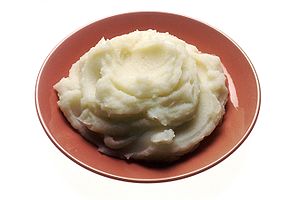 |
| Mashed Potatoes |
Recipes for making the dish started appearing in 1747 with an entry in The Art of Cookery by Hannah Glasse. Dehydrated and frozen mashed potatoes are available in many supermarkets.
Mashed potato may be used as an intermediary ingredient for other dishes such as dumplings and gnocchi, in which case the potatoes may be baked or boiled, and may or may not have dairy or seasoning added.
The use of "floury" types of potatoes is recommended, although "waxy" potatoes are sometimes used for a different texture. There are a multitude of "floury" types, but the most commonly known include russet, golden wonder, and red rascal potatoes. Butter, vegetable oil, milk and/or cream are usually added to improve flavor and texture, and the potatoes are seasoned with salt, pepper, and any other desired herbs and spices. Popular ingredients and seasonings include: garlic, cheese, bacon bits, sour cream, crisp onion or spring onion, caramelised onion, mayonnaise, mustard, horseradish, spices such as nutmeg, and chopped herbs such as parsley.
One French variation adds egg yolk for pommes duchesse or Duchess potatoes; piped through a pastry tube into wavy ribbons and rosettes, brushed with butter and lightly browned. Pomme purée (potato puree) uses considerably more butter than normal mashed potato - up to one part butter for every two parts potato. In low-calorie or non-dairy variations, milk, cream and butter may be replaced by soup stock or broth. Aloo Bharta, an Indian sub-continent variation, uses chopped onions, mustard (oil, paste or seeds), chili pepper, coriander leaves and other spices.
Mashed potato can be served as a side dish, and is often served with sausages in the British Isles,
 |
| Mashed potato served with Frankfurter Rippchen, sauerkraut and mustard |
In the United Kingdom, the cold mashed potato is mixed with fresh eggs and then fried until crisp to produce the potato cake. This dish is thought to have originated in Cornwall and is a popular breakfast item. When instead combined with meat and other leftover vegetables, the fried dish is known as bubble and squeak.
A popular accompaniment to mashed potatoes in the United States is gravy. The most common forms of gravy paired with mashed potatoes are beef gravy or turkey gravy, though vegetable gravy is becoming more common as the vegetarian and vegan trends see a rise in popularity.
A potato masher is a utensil which can be used to prepare the potatoes, as is a potato ricer. They may also be whipped with an electric hand mixer, or with sufficient boiling, can be mashed effectively with a durable wooden spoon and brute force.
Tuesday, December 4, 2018
Healthy French Toast Recipes
From the EatingWell website and Magazine its Healthy French Toast Recipes. Start your day off with some delicious and healthy French Toast with recipes like; Pumpkin-Walnut Baked French Toast with Maple-Coffee Syrup, Maple-Apple Drenched French Toast, and Stuffed French Toast. Find these recipes and more all at the EatingWell website. Enjoy and Eat Healthy in 2018! http://www.eatingwell.com/
Healthy French Toast Recipes
 Find healthy, delicious French toast recipes including cinnamon and low-calorie French toast. Healthier recipes, from the food and nutrition experts at EatingWell.
Pumpkin-Walnut Baked French Toast with Maple-Coffee Syrup
This overnight French toast recipe is especially tasty with the addition of canned pumpkin and spices. Topped with a coffee-flavored maple syrup and optional fruit, it's sure to be a fall or winter favorite with everyone at your table.........
Maple-Apple Drenched French Toast
Topped with tasty pecans and a delicious apple and maple syrup blend, this French toast is sure to become a go-to recipe for special breakfasts or brunches...............
Stuffed French Toast
One slice of French toast oozing with cream cheese and drizzled with melted fruit spread does not have many more calories or grams of fat than a bowl of most breakfast cereals......
* Click the link below to get all the Healthy French Toast Recipes
http://www.eatingwell.com/recipes/22784/mealtimes/breakfast-brunch/toast/french-toast/
Healthy French Toast Recipes
Pumpkin-Walnut Baked French Toast with Maple-Coffee Syrup
This overnight French toast recipe is especially tasty with the addition of canned pumpkin and spices. Topped with a coffee-flavored maple syrup and optional fruit, it's sure to be a fall or winter favorite with everyone at your table.........
Maple-Apple Drenched French Toast
Topped with tasty pecans and a delicious apple and maple syrup blend, this French toast is sure to become a go-to recipe for special breakfasts or brunches...............
Stuffed French Toast
One slice of French toast oozing with cream cheese and drizzled with melted fruit spread does not have many more calories or grams of fat than a bowl of most breakfast cereals......
* Click the link below to get all the Healthy French Toast Recipes
http://www.eatingwell.com/recipes/22784/mealtimes/breakfast-brunch/toast/french-toast/
Wednesday, April 11, 2018
Healthy Dairy Recipes
From the EatingWell website and Magazine its Healthy Dairy Recipes. Delicious and Healthy Dairy Recipes like; Skillet Pull-Apart Bread with Spinach-Artichoke Dip, Yogurt with Blueberries and Honey, and Chicken Shawarma with Yogurt Sauce. Find these recipes and much more all at the EatingWell website. Enjoy and Eat Healthy in 2018! http://www.eatingwell.com/
Healthy Dairy Recipes
Find healthy, delicious dairy recipes including yogurt, cheese, milk and cottage cheese. Healthier recipes, from the food and nutrition experts at EatingWell.
Skillet Pull-Apart Bread with Spinach-Artichoke Dip
Make this creamy, cheesy dip with bread for dipping all in one pan for a simple, crowd-pleasing party appetizer. We use whole-wheat pizza dough for the easy pull-apart bread edge.............
Yogurt with Blueberries and Honey
A simple combination of Greek yogurt and blueberries gets an extra touch of sweetness from golden honey. It's the perfect balance of protein and fiber to keep you energized........
Chicken Shawarma with Yogurt Sauce
The key to cooking juicy chicken without a spit in this healthy recipe is high heat and dark meat. The yogurt in the marinade gives the chicken both its tender texture and its alluring char. More yogurt in the sauce, along with crunchy cucumbers and herbs, keeps the flavors bright..................
* Click the link below to get all the Healthy Dairy Recipes
http://www.eatingwell.com/recipes/18242/ingredients/dairy/
Healthy Dairy Recipes
Skillet Pull-Apart Bread with Spinach-Artichoke Dip
Make this creamy, cheesy dip with bread for dipping all in one pan for a simple, crowd-pleasing party appetizer. We use whole-wheat pizza dough for the easy pull-apart bread edge.............
Yogurt with Blueberries and Honey
A simple combination of Greek yogurt and blueberries gets an extra touch of sweetness from golden honey. It's the perfect balance of protein and fiber to keep you energized........
Chicken Shawarma with Yogurt Sauce
The key to cooking juicy chicken without a spit in this healthy recipe is high heat and dark meat. The yogurt in the marinade gives the chicken both its tender texture and its alluring char. More yogurt in the sauce, along with crunchy cucumbers and herbs, keeps the flavors bright..................
* Click the link below to get all the Healthy Dairy Recipes
http://www.eatingwell.com/recipes/18242/ingredients/dairy/
Sunday, December 31, 2017
Kitchen Hint of the Day!
Thank you to Gina W. for passing this hint along.......
When boiling milk, first stir in a pinch of baking soda. This will help keep the milk from curdling.
When boiling milk, first stir in a pinch of baking soda. This will help keep the milk from curdling.
Wednesday, November 8, 2017
Kitchen Hint of the Day!
Omelet time......
To make a tastier and fluffier omelet; Add a little milk or a tbsp of water when beating eggs. Enjoy your Breakfast!
To make a tastier and fluffier omelet; Add a little milk or a tbsp of water when beating eggs. Enjoy your Breakfast!
Monday, July 3, 2017
One of America's Favorites - Milk Toast
 |
| Simple milk toast consisting of toasted buttermilk bread |
Milk toast is a breakfast food consisting of toasted bread in warm milk, typically with sugar and butter. Salt, pepper, paprika, cinnamon, cocoa, raisins and other ingredients may be added. In the New England region of the US, milk toast refers to toast that has been dipped in a milk-based white sauce. Milk toast was a popular food throughout the late 19th and early 20th centuries, especially for young children and for the convalescent, for whom the food was thought to be soothing and easy to digest. Although not as popular in the 2000s, milk toast is still considered a comfort food.
The food writer M. F. K. Fisher (1908–1992) called milk toast a "warm, mild, soothing thing, full of innocent strength", and wrote, of eating milk toast in a famed restaurant with a convalescent friend, that the food was "a small modern miracle of gastronomy". She notes that her homeliest kitchen manuals even list it under Feeding The Sick or Invalid Recipes, arguing that milk toast was "an instinctive palliative, something like boiled water". Fisher also notes that for true comfort, a ritual may be necessary, and for Milk Toast people, the dish used may be foolishly important. Her favorite version of milk toast has the milk mixed 50/50 with Campbell's condensed cream of tomato soup in a wide-lipped pitcher called a boccalino in Italian Switzerland where she got it.
In the Southwestern United States
 |
| Milk toast prepared with condensed milk |
Milk toast's soft blandness served as inspiration for the name of the timid and ineffectual comic strip character Caspar Milquetoast, drawn by H. T. Webster from 1924 to 1952. Thus, the term "milquetoast" entered the language as the label for a timid, shrinking, apologetic person. Milk toast also appeared in Disney's Follow Me Boys as an undesirable breakfast for the aging main character Lem Siddons.
Sunday, May 28, 2017
Soup Special of the Day!.........Butternut Squash Soup
This week's Soup Special of the Day is a Butternut Squash Soup. Enjoy and Eat Healthy!
Butternut Squash Soup
Recipe Ingredients:
1 teaspoon extra light olive oil
1 green onion, chopped
2 pounds butternut squash, peeled and diced
1 cup water
1/4 teaspoon roasted cumin
1/4 teaspoon dried thyme
2 teaspoons all-purpose flour
2 1/2 cups chicken broth
1/2 cup 2% milk
Nutmeg for sprinkling
Cooking Directions:
1 - In a 5-quart Dutch oven or saucepot heat olive oil over low heat. Add chopped green onion (white part only); sauté until browned, about 2 minutes.
2 - Add peeled, seeded, and diced butternut squash, water, cumin, and thyme. Cover and simmer for 10 to 15 minutes or until squash is tender.
3 - Stir in flour. Cook for 1 minute. Add chicken broth; bringing to a boil. Reduce the heat and simmer, uncovered, for 10 minutes.
4 - Remove from the heat and stir in milk.
5 - In a blender or food processor, blend squash mixture at low speed in batches until smooth. (Caution! Hot liquids create steam which will blow the top off the blender! Be sure to securely hold blender lid down!)
6 - Serve soup with sprinkled nutmeg.
* A baked crusty bread would go great with this (optional)
Makes 6 servings.
Butternut Squash Soup
Recipe Ingredients:
1 teaspoon extra light olive oil
1 green onion, chopped
2 pounds butternut squash, peeled and diced
1 cup water
1/4 teaspoon roasted cumin
1/4 teaspoon dried thyme
2 teaspoons all-purpose flour
2 1/2 cups chicken broth
1/2 cup 2% milk
Nutmeg for sprinkling
Cooking Directions:
1 - In a 5-quart Dutch oven or saucepot heat olive oil over low heat. Add chopped green onion (white part only); sauté until browned, about 2 minutes.
2 - Add peeled, seeded, and diced butternut squash, water, cumin, and thyme. Cover and simmer for 10 to 15 minutes or until squash is tender.
3 - Stir in flour. Cook for 1 minute. Add chicken broth; bringing to a boil. Reduce the heat and simmer, uncovered, for 10 minutes.
4 - Remove from the heat and stir in milk.
5 - In a blender or food processor, blend squash mixture at low speed in batches until smooth. (Caution! Hot liquids create steam which will blow the top off the blender! Be sure to securely hold blender lid down!)
6 - Serve soup with sprinkled nutmeg.
* A baked crusty bread would go great with this (optional)
Makes 6 servings.
Tuesday, May 2, 2017
Kitchen Hint of the Day!
Less Fat and Calories in your diet........
A good way to decrease the amount of fat and calories in your recipes is to use fat-free milk or 1% milk instead of whole or reduced-fat (2%) milk. For extra richness, try fat-free half-and-half or evaporated skim milk.
A good way to decrease the amount of fat and calories in your recipes is to use fat-free milk or 1% milk instead of whole or reduced-fat (2%) milk. For extra richness, try fat-free half-and-half or evaporated skim milk.
Wednesday, April 12, 2017
Kitchen Hint of the Day!
Did you know that you can freeze.......
All these everyday ingredients will freeze well......
* Butter and margarine can be frozen for 3 months.
* Grated cheese can be frozen for up to 4 months and can be used straight from the freezer.
* Most bread, except crusty varieties such as French bread, will freeze well for up to 3 months. Sliced bread can be toasted from frozen.
* Milk will freeze for 1 month. Defrost in the fridge and shake well before using.
* Raw pastry will freeze for for 6 months and takes just 1 hour to thaw.
All these everyday ingredients will freeze well......
* Butter and margarine can be frozen for 3 months.
* Grated cheese can be frozen for up to 4 months and can be used straight from the freezer.
* Most bread, except crusty varieties such as French bread, will freeze well for up to 3 months. Sliced bread can be toasted from frozen.
* Milk will freeze for 1 month. Defrost in the fridge and shake well before using.
* Raw pastry will freeze for for 6 months and takes just 1 hour to thaw.
Sunday, February 26, 2017
Kitchen Hint of the Day!
Love that Buttermilk.....
Buttermilk can be substituted for 2 percent or whole milk in most pastry or bread recipes. Buttermilk is less than 1 percent fat, almost equal to skim milk, but has a thicker consistency.
Buttermilk can be substituted for 2 percent or whole milk in most pastry or bread recipes. Buttermilk is less than 1 percent fat, almost equal to skim milk, but has a thicker consistency.
Friday, February 24, 2017
Kitchen Hint of the Day!
Cutting fat and calories......
A good way to decrease the amount of fat and calories in your recipes is to use fat-free milk or 1% milk instead of whole or reduced-fat (2%) milk. For extra richness, try fat-free half-and-half or evaporated skim milk.
A good way to decrease the amount of fat and calories in your recipes is to use fat-free milk or 1% milk instead of whole or reduced-fat (2%) milk. For extra richness, try fat-free half-and-half or evaporated skim milk.
Monday, January 30, 2017
One of America's Favorites - Buttermilk
Buttermilk refers to a number of dairy drinks. Originally, buttermilk was the liquid left behind after
churning butter out of cream. This type of buttermilk is known as traditional buttermilk.
The term buttermilk also refers to a range of fermented milk drinks, common in warm climates (e.g., the Balkans, the Middle East, Turkey, Afghanistan, Pakistan, Nepal, India, Sri Lanka, Nicaragua and the Southern United States) where unrefrigerated fresh milk sours quickly, as well as in colder climates, such as Scandinavia, Ireland, the Netherlands, Germany, Poland, Slovakia, Slovenia, Croatia and the Czech Republic. This fermented dairy product known as cultured buttermilk is produced from cow's milk and has a characteristically sour taste caused by lactic acid bacteria. This variant is made using one of two species of bacteria—either Lactococcus lactis or Lactobacillus bulgaricus, which creates more tartness.
The tartness of buttermilk is due to acid in the milk. The increased acidity is primarily due to lactic acid produced by lactic acid bacteria while fermenting lactose, the primary sugar in milk. As the bacteria produce lactic acid, the pH of the milk decreases and casein, the primary milk protein, precipitates, causing the curdling or clabbering of milk. This process makes buttermilk thicker than plain milk. While both traditional and cultured buttermilk contain lactic acid, traditional buttermilk tends to be less viscous, whereas cultured buttermilk is more viscous.
Buttermilk can be drunk straight, and it can also be used in cooking. Soda bread is a bread in which the acid in buttermilk reacts with the rising agent, sodium bicarbonate, to produce carbon dioxide which acts as the leavening agent. Buttermilk is also used in marination, especially of chicken and pork, whereby the lactic acid helps to tenderize, retain moisture, and allows added flavors to permeate throughout the meat.
 |
| Buttermilk right compared to fresh milk left |
The term buttermilk also refers to a range of fermented milk drinks, common in warm climates (e.g., the Balkans, the Middle East, Turkey, Afghanistan, Pakistan, Nepal, India, Sri Lanka, Nicaragua and the Southern United States) where unrefrigerated fresh milk sours quickly, as well as in colder climates, such as Scandinavia, Ireland, the Netherlands, Germany, Poland, Slovakia, Slovenia, Croatia and the Czech Republic. This fermented dairy product known as cultured buttermilk is produced from cow's milk and has a characteristically sour taste caused by lactic acid bacteria. This variant is made using one of two species of bacteria—either Lactococcus lactis or Lactobacillus bulgaricus, which creates more tartness.
The tartness of buttermilk is due to acid in the milk. The increased acidity is primarily due to lactic acid produced by lactic acid bacteria while fermenting lactose, the primary sugar in milk. As the bacteria produce lactic acid, the pH of the milk decreases and casein, the primary milk protein, precipitates, causing the curdling or clabbering of milk. This process makes buttermilk thicker than plain milk. While both traditional and cultured buttermilk contain lactic acid, traditional buttermilk tends to be less viscous, whereas cultured buttermilk is more viscous.
Buttermilk can be drunk straight, and it can also be used in cooking. Soda bread is a bread in which the acid in buttermilk reacts with the rising agent, sodium bicarbonate, to produce carbon dioxide which acts as the leavening agent. Buttermilk is also used in marination, especially of chicken and pork, whereby the lactic acid helps to tenderize, retain moisture, and allows added flavors to permeate throughout the meat.
Friday, January 27, 2017
Kitchen Hint of the Day!
Thinking of making your own Bread........
For a shiny bread crust, brush the top with a mixture of 1 beaten egg and 1 tablespoon of milk before baking.
For a shiny bread crust, brush the top with a mixture of 1 beaten egg and 1 tablespoon of milk before baking.
Friday, December 23, 2016
A Christmas Favorite - Eggnog
Eggnog /ˈɛɡˌnɒɡ/ (or egg nog), historically also known (when alcoholic) as milk punch or egg milk
punch, is a rich, chilled, sweetened, creamy dairy-based beverage traditionally made with milk, cream, sugar, whipped eggs (which gives it a frothy texture, and its name) and, in some contexts, distilled spirits such as brandy, rum or bourbon.
Eggnog is traditionally consumed throughout Canada and the United States at Christmas every year, often from American Thanksgiving through the end of the Christmas season. A variety called Ponche Crema has been made and consumed in Venezuela and Trinidad since the 1900s, also in the Christmas season. During this period commercially prepared eggnog is sold in grocery stores in these countries. Eggnog is also often homemade. Distilled spirits are sometimes added to both commercially prepared eggnog and homemade eggnog. Eggnog or eggnog flavoring may also be used in other drinks, such as coffee (e.g. an "eggnog latte" espresso drink) and tea, or to dessert foods such as egg-custard puddings or eggnog-flavored ice cream.
Traditional eggnog is made of milk or cream, sugar, raw eggs, an alcoholic spirit, and spices, often
vanilla or nutmeg. In some recipes, vanilla flavor is added. Some modern commercial eggnogs add gelatin and other thickeners, with less egg and cream. There are variations in ingredients, and toppings may be added, such as grated nutmeg or ground cinnamon. Eggnog can be made commercially, as well as at home. Ready-made eggnog versions are seasonally available with different spirits, or without alcohol, to be drunk as bought or used as "mixes" with all the ingredients except the liquor, to be added as desired. Traditional eggnog has a significant fat content, due to the use of cream, and a high sugar content; low-fat and sugar-free formulations are available using skimmed or low fat milk.
Dutch advocaat with around 20% alcohol, long sold in bottles, is essentially an eggnog. Under current U.S. law, commercial products sold as eggnog are permitted to contain milk, sugar, modified milk ingredients, glucose-fructose, water, carrageenan, guar gum, natural and artificial flavorings, spices, monoglycerides, and coloring. Ingredients vary significantly between variants. Alcohol used in different national and regional versions of eggnog include brandy, cognac, bourbon, whiskey, sherry, rum and grain alcohol.
Some North American manufacturers offer soy-, almond-, rice- or coconut milk-based alternatives for vegans and those with dairy allergies, lactose intolerance or other dietary restrictions.
The history of non-dairy eggnogs goes back to at least 1899 when Almeda Lambert, in her Guide for
Nut Cookery, gave a recipe for "Egg Nog" made using coconut cream, eggs, and sugar. In 1973, Eunice Farmilant, in The Natural Foods Sweet-Tooth Cookbook, gave a more modern non-dairy eggnog recipe using 3 eggs separated, 2 tablespoons of barley malt extract or Amasake syrup, 4 cups of chilled soy milk, 1 teaspoon of vanilla extract, and nutmeg, (p. 138-39)
In 1981, Grain Country of Los Angeles, California, introduced Grain Nog, the earliest non-dairy and vegan eggnog. Based on amazake (a traditional Japanese fermented rice beverage) and containing no eggs, it was available in plain, strawberry, and carob flavors. Also in 1981, Redwood Valley Soyfoods Unlimited (California) introduced "Soynog", the earliest known soy-based non-dairy and vegan eggnog based on soy milk and tofu (added for thickness). It was renamed Lite Nog in 1982 and Tofu Nog in 1985.
 |
| Eggnog with cinnamon |
Eggnog is traditionally consumed throughout Canada and the United States at Christmas every year, often from American Thanksgiving through the end of the Christmas season. A variety called Ponche Crema has been made and consumed in Venezuela and Trinidad since the 1900s, also in the Christmas season. During this period commercially prepared eggnog is sold in grocery stores in these countries. Eggnog is also often homemade. Distilled spirits are sometimes added to both commercially prepared eggnog and homemade eggnog. Eggnog or eggnog flavoring may also be used in other drinks, such as coffee (e.g. an "eggnog latte" espresso drink) and tea, or to dessert foods such as egg-custard puddings or eggnog-flavored ice cream.
Traditional eggnog is made of milk or cream, sugar, raw eggs, an alcoholic spirit, and spices, often
 |
| Traditional eggnog typically consists of milk, sugar and raw eggs. |
Dutch advocaat with around 20% alcohol, long sold in bottles, is essentially an eggnog. Under current U.S. law, commercial products sold as eggnog are permitted to contain milk, sugar, modified milk ingredients, glucose-fructose, water, carrageenan, guar gum, natural and artificial flavorings, spices, monoglycerides, and coloring. Ingredients vary significantly between variants. Alcohol used in different national and regional versions of eggnog include brandy, cognac, bourbon, whiskey, sherry, rum and grain alcohol.
Some North American manufacturers offer soy-, almond-, rice- or coconut milk-based alternatives for vegans and those with dairy allergies, lactose intolerance or other dietary restrictions.
The history of non-dairy eggnogs goes back to at least 1899 when Almeda Lambert, in her Guide for
 |
| "Silk Nog," a commercial soy milk eggnog. |
In 1981, Grain Country of Los Angeles, California, introduced Grain Nog, the earliest non-dairy and vegan eggnog. Based on amazake (a traditional Japanese fermented rice beverage) and containing no eggs, it was available in plain, strawberry, and carob flavors. Also in 1981, Redwood Valley Soyfoods Unlimited (California) introduced "Soynog", the earliest known soy-based non-dairy and vegan eggnog based on soy milk and tofu (added for thickness). It was renamed Lite Nog in 1982 and Tofu Nog in 1985.
Saturday, December 3, 2016
Kitchen Hint of the Day!
When baking....
Unless otherwise specified in the recipe, all ingredients should be at room temperature, normally around 70 degrees. If ingredients have been refrigerated, such as milk, eggs, and butter, let them sit out at room temperature for 15 to 25 minutes before using. When ingredients are at room temperature, butter and sugar will cream properly and hold more air, eggs will blend well into the batter to act as an emulsifier, egg whites are easier to beat, and dry ingredients will combine easier. Now Bake!
Unless otherwise specified in the recipe, all ingredients should be at room temperature, normally around 70 degrees. If ingredients have been refrigerated, such as milk, eggs, and butter, let them sit out at room temperature for 15 to 25 minutes before using. When ingredients are at room temperature, butter and sugar will cream properly and hold more air, eggs will blend well into the batter to act as an emulsifier, egg whites are easier to beat, and dry ingredients will combine easier. Now Bake!
Thursday, October 13, 2016
Kitchen Hint of the Day!
When baking.....
If ingredients have been refrigerated, such as milk, eggs, and butter, let them sit out at room temperature for 20 to 30 minutes before using. When ingredients are at room temperature, butter and sugar will cream properly and hold more air, eggs will blend well into the batter to act as an emulsifier, egg whites are easier to beat, and dry ingredients will combine easier.
If ingredients have been refrigerated, such as milk, eggs, and butter, let them sit out at room temperature for 20 to 30 minutes before using. When ingredients are at room temperature, butter and sugar will cream properly and hold more air, eggs will blend well into the batter to act as an emulsifier, egg whites are easier to beat, and dry ingredients will combine easier.
Sunday, October 2, 2016
Kitchen Hint of the Day!
Make those Rolls Special.....
Before you put rolls in the oven, make a delicious glaze for their tops. Lightly beat an egg white with a tablespoon of milk and brush on each roll. Everyone will love them!
Before you put rolls in the oven, make a delicious glaze for their tops. Lightly beat an egg white with a tablespoon of milk and brush on each roll. Everyone will love them!
Thursday, August 18, 2016
Kitchen Hint of the Day!
Drink the Milk....
A way to decrease the amount of fat and calories in your recipes is to use fat-free milk or 1% milk instead of whole or reduced-fat (2%) milk. For extra richness, try fat-free half-and-half or evaporated skim milk.
A way to decrease the amount of fat and calories in your recipes is to use fat-free milk or 1% milk instead of whole or reduced-fat (2%) milk. For extra richness, try fat-free half-and-half or evaporated skim milk.
Subscribe to:
Posts (Atom)